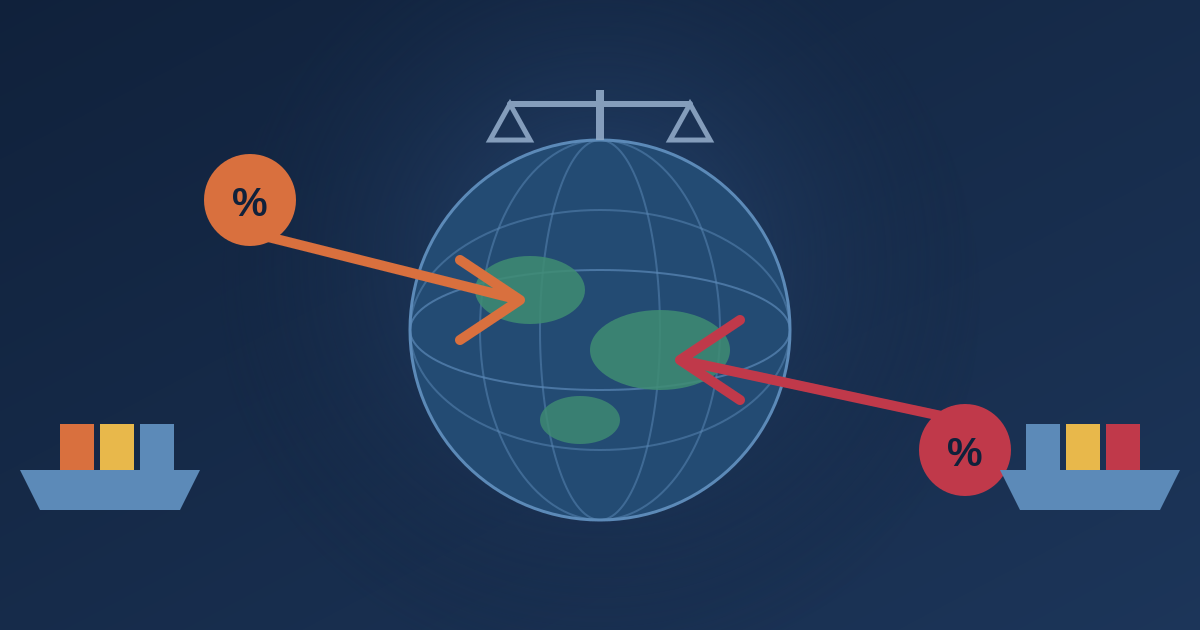
On the afternoon of April 2, 2025, President Trump stepped into the White House Rose Garden and announced what he called "Liberation Day" — a sweeping new tariff regime imposing a 10 percent baseline levy on every country that exports goods to the United States, with country-specific rates running as high as 50 percent for named trading partners. It was, as analysts immediately noted, the most aggressive tariff action since the Smoot-Hawley Act of 1930, the law best remembered for triggering a global trade war and deepening the Great Depression.
Markets reacted accordingly. The S&P 500 lost $5.83 trillion in market value over the days that followed. The 30-year US Treasury rate posted its largest three-day rise since 1982 as foreign investors questioned the safe-haven status of American assets. The dollar index fell more than 4 percent to a three-year low. Retaliation came from three continents within days.
Meanwhile, on a different front of the same broader campaign, the European Union was in the middle of its 18th package of sanctions against Russia — a document targeting shadow fleet shipping networks, cryptocurrency service providers, banks in third countries, and an expanding list of energy sector entities so complex that major financial institutions now maintain dedicated compliance software just to track which transactions remain legal. By the time the EU published its 20th sanctions package in May 2026, more than 2,500 individuals and entities were subject to asset freezes, 557 vessels had been designated under port-access bans, and the compliance burden had become a significant line item in the operating budgets of any institution with exposure to the global energy trade.
These two things — Liberation Day tariffs and the Russia sanctions architecture — are symptoms of the same underlying shift: trade policy has been transformed from a tool of economic management into a primary instrument of geopolitical power. Understanding how that transformation happened, what it costs, and how durable it is matters to anyone who holds investments, buys groceries, or simply wants to understand why the global economy works the way it now does.
How Trade Became a Weapon
The traditional case for tariffs was straightforward: they protect domestic industries from unfair foreign competition, providing time for vulnerable sectors to modernize or adjust. They could also serve as leverage in bilateral trade negotiations, giving governments something to threaten or offer. This justification hasn't disappeared. But it has been comprehensively joined — and in many cases displaced — by something newer and more explicitly strategic.
At Davos in January 2026, US Trade Representative Jamieson Greer made the shift official in unusually direct language. Tariffs, he told journalists, sit "alongside export controls and sanctions" in the national security toolkit. "Previous presidents have used other economic tools," he said. "Tariffs fall within that spectrum." This was not the traditional framing of a trade official defending domestic industry. It was the language of statecraft — of economic instruments understood as alternatives to, and enablers of, foreign policy objectives.
Researchers at the Peterson Institute for International Economics had been tracking this trajectory for years. Their analysis of recent tariff rounds found them functioning less like economic correctives and more like instruments of coercion — aimed at extracting concessions on issues entirely unrelated to trade: immigration enforcement, military basing rights, currency policy, and diplomatic posturing. The Liberation Day announcement itself was publicly framed not primarily as a response to specific trade practices but as a declaration of economic independence and a correction of what the administration called decades of unfair treatment. The targets included longstanding allies — the European Union, Japan, South Korea — alongside rivals.
Export controls have followed an identical trajectory, and in some respects represent an even more consequential weaponization of economic tools. The semiconductor export controls that the US has ratcheted tighter since 2022 — restricting access to advanced chips, the lithography machines that manufacture them, and the electronic design automation software that enables them — are not primarily about protecting a domestic chip industry. They are an attempt to deny a strategic competitor the computing infrastructure required for next-generation military systems and artificial intelligence development. A Congressional Research Service analysis updated in September 2025 described the controls as targeting China's ability to build advanced AI at scale, not just its chip sector.
The policy has produced real effects. Chinese semiconductor companies have faced price spikes, supply disruptions, and workforce reductions. But it has also produced a countermove that complicates the strategic logic. In March 2025, researchers at Peking University announced a new approach to chip manufacturing using alternative materials that they claimed could circumvent the silicon-based roadblocks the export controls target. In early 2026, China implemented its own sweeping export controls on rare earths and permanent magnets — materials for which China controls roughly 90 percent of global processing — creating reciprocal pressure on Western defense supply chains, including components essential to the F-35 fighter jet, submarines, and missile systems. The Center for Strategic and International Studies concluded in a May 2026 analysis that chip export controls alone would "largely fail" in their aim, because the controls themselves accelerate China's domestic development effort while eroding the revenue base of American chipmakers.
Sanctions: The Scalpel of Modern Statecraft
If tariffs are the blunt instrument of economic statecraft, sanctions represent its more surgical application — though "surgical" has become an increasingly strained metaphor as the programs have multiplied and layered.
The United States currently maintains more than two dozen separate sanctions regimes, according to the Council on Foreign Relations, covering counterterrorism, nuclear nonproliferation, human rights abuses, election interference, cybercrime, and narcotics trafficking. The Russia sanctions, which began accumulating after the 2014 annexation of Crimea and expanded dramatically after the full-scale invasion of Ukraine in February 2022, represent the most complex sanctions architecture ever constructed by the Western alliance. By the time the EU published its 19th package in October 2025, the measures encompassed major Russian energy companies, hundreds of shadow fleet vessels, financial institutions, crypto providers, and third-country companies in the UAE, India, Hong Kong, and China that were facilitating circumvention.
Sanctions occupy a politically attractive middle ground: they impose real costs on targets without the diplomatic exposure of military action or the domestic political risk of inaction. They are visible — sanctions lists are published, designations are announced — which gives governments the ability to demonstrate resolve to domestic audiences. And they are flexible, allowing for escalation and de-escalation without the irreversibility of deployed force.
The costs, however, are real and frequently spill beyond the intended targets. Energy sanctions on Russia contributed to the European energy shock of 2022–2023, raising household heating bills and industrial energy costs across the continent in ways that fueled political turbulence from Germany to Italy. Allied economies were caught between their commitments to the sanctions regime and the immediate pain of energy market disruption. Financial institutions in countries that had no particular stake in the Russia-Ukraine conflict found themselves spending significant resources on compliance with rules that shifted every few months — the Atlantic Council's Energy Sanctions Dashboard documented China saving up to $28.8 million per day at peak discount levels by purchasing Russian crude at prices discounted precisely because Western sanctions had narrowed Russia's buyer pool.
There is also the structural erosion problem, and it operates on a timeline that makes it easy to ignore in the short term and impossible to ignore in the long term. Every sanctions package gives targeted states stronger incentives to build durable workarounds. Russia rerouted oil exports through a shadow fleet and alternative buyers — primarily China and India — that cushioned the economic blow. BRICS nations have accelerated discussions on non-dollar trade settlement, and the frequency with which alternative payment systems appear on BRICS summit agendas has become, as one former senior Treasury official noted at a Council on Foreign Relations event in April 2026, "medium to long term, worrying." Even European capitals have begun asking whether their dependence on dollar-denominated systems and American financial infrastructure creates vulnerabilities they should reduce.
A Congressional Research Service analysis found that sanctions on Russia had "mixed economic impacts" — successfully reducing Western dependency on Russian energy while generating global inflation and energy shortages as unintended consequences. The key phrase is "mixed." Sanctions inflicted real economic damage on Russia, but Russia's pre-invasion structural adaptations — building reserve currency holdings, cultivating alternative trading relationships, developing domestic payment infrastructure — significantly mitigated their full impact. The price cap on Russian oil, designed to reduce revenue while keeping oil flowing to prevent a global supply shock, is a particularly instructive example: it created persistent discounts on Russian crude sold to China and India, which benefited those buyers considerably, while failing to achieve the revenue reduction its designers targeted.
What It Costs on Kitchen Tables
The domestic economic consequences of this era of weaponized trade rarely get framed as foreign policy outcomes, but they are.
The Yale Budget Lab's detailed analysis of the 2025 tariff environment found that by May 2025, American consumers faced an overall average effective tariff rate of 17.8 percent — the highest since 1934. The price level impact translated to an average per-household income loss of roughly $2,300 to $2,800 in 2024 dollars, with the burden falling disproportionately on lower-income households that spend more of their income on goods and less on services. Clothing and textiles took the sharpest direct hit: the Budget Lab found shoe prices up 87 percent and apparel prices up 65 percent in the short run. One year after Liberation Day, a Council on Foreign Relations assessment found that tariff costs had been passed through to consumers at a rate of up to 96 percent for many consumer goods — the argument that exporters would absorb the costs had not materialized at scale.
The macroeconomic toll was also measurable. The Budget Lab estimated that the combination of 2025 tariffs and foreign retaliation reduced real US GDP growth by 0.7 percentage points over the calendar year and left payroll employment approximately 456,000 lower than it would otherwise have been. US exports fell by an estimated 15.5 percent on a long-run basis. The Tax Foundation's one-year review concluded that the Liberation Day tariffs "were not reciprocal, did not produce a surge in investment or manufacturing employment, generated less revenue than projected, did not pay down the national debt, and contributed to higher prices and weaker economic activity."
These outcomes don't settle the broader policy debate — defenders of the tariff approach argue that short-term adjustment costs are the price of reducing structural dependencies, and that supply chain reshoring takes years to measure. But they do establish what the current approach costs while those long-term benefits remain hypothetical, and who pays for it in the interim.
The Limits of Economic Weapons
None of this means tariffs and sanctions are inherently unjustified tools. Targeted sanctions have a documented record of curbing weapons proliferation — the Iran nuclear deal, whatever its subsequent fate, represented real constraints on a nuclear program that sanctions had significantly damaged. Arms embargo regimes have slowed the flow of weapons into conflict zones. Export controls on advanced military technologies have kept meaningful capabilities out of adversary hands for meaningful periods. The distinction between tools used precisely, with clear objectives and defined endpoints, and tools used reflexively as a first response to every diplomatic friction, matters enormously.
What the evidence of the past several years suggests is that the reflexive application has become the norm. Tariffs have been imposed on allies and adversaries alike to extract concessions on issues ranging from immigration to military spending. Sanctions regimes have expanded to the point where the compliance burden falls on the entire global financial system, not just the targeted parties. Export controls have been layered so densely that the strategic logic in some cases has been overtaken by commercial and diplomatic blowback.
The structural consequence is a gradual erosion of the leverage these tools depend on. An America that imposes tariffs on everyone has given every country a reason to build trade arrangements that bypass American markets. A sanctions regime that is applied so broadly that it disrupts the economies of neutral third countries gives those countries reason to build the alternative payment infrastructure that, once operational, makes future sanctions less effective. The Chatham House analysis from April 2026 concluded that AI and chip export controls "alone will largely fail" in their strategic aims because the controls themselves accelerate the domestic development they aim to prevent. What is true of chips is likely true of economic coercion more broadly: when the target has the capacity and the incentive to adapt, the effectiveness of the tool has a shelf life.
The deeper question — one that economists, strategists, and policymakers haven't resolved — is whether the United States is spending down strategic capital that took seventy years to accumulate. The post-war international economic architecture that the US designed and led was built on predictable rules, open markets, and institutions that gave other countries reasons to remain aligned with American interests. Whether the current approach replaces that architecture with something equally durable, or simply fragments it into a set of bilateral and regional arrangements less favorable to American influence, is the defining strategic question of the current era.
For voters and investors navigating this environment, the practical implications are more immediate: supply chains are being restructured, prices are elevated relative to where they would otherwise be, and the global economic rules that businesses and households have operated under for decades are being rewritten in real time. Understanding what's driving those changes — not just the headline announcements but the underlying logic and the documented costs — is the first requirement for making sense of what's coming next.
What aspect of trade policy's transformation do you think deserves more public attention — the tariffs, the export controls, or the sanctions regimes? Share your perspective in the comments below.