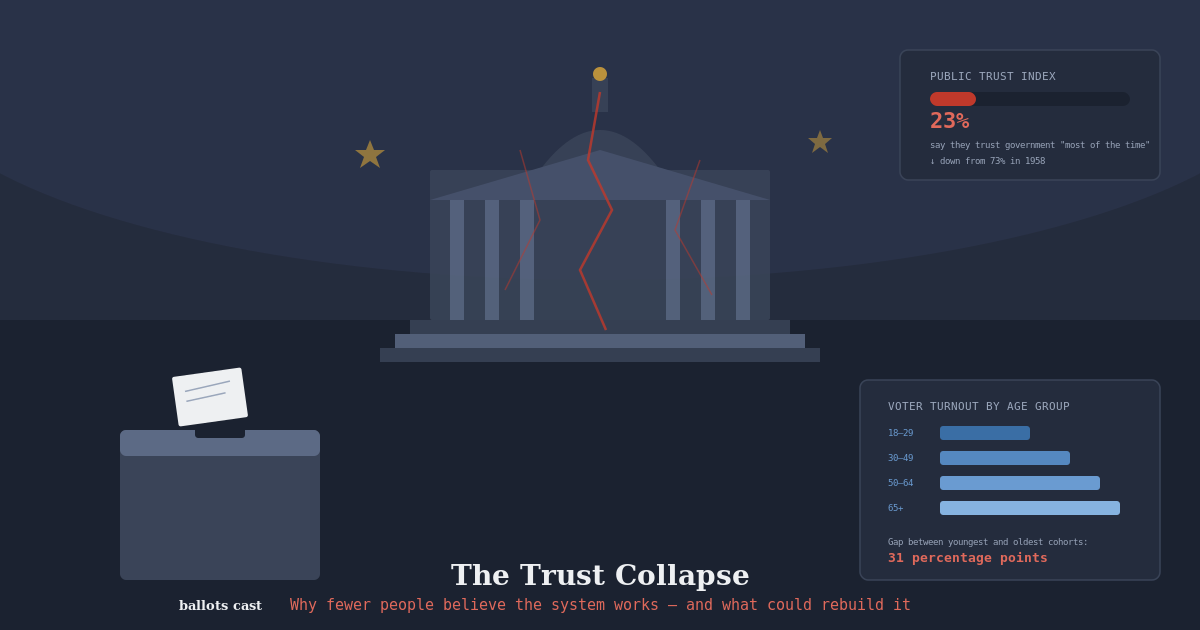
In 1958, 73% of Americans said they trusted the federal government to do the right thing most of the time. According to long-running data compiled by the Pew Research Center, that figure now sits at around 22%. That is not a dip or a cyclical fluctuation. It is a multi-generational collapse — one that has unfolded slowly enough that most people never noticed the floor disappearing beneath them.
The numbers get worse on closer inspection. Pew's 2024 survey found that 85% of Americans say elected officials do not care what people like them think. Around seven in ten have an unfavourable view of Congress. Unfavourable views of the Supreme Court exceeded favourable ones for the first time in the history of the question. And this is not a uniquely American problem. The 2025 Edelman Trust Barometer — an annual survey of over 33,000 people across 28 countries — found that six in ten respondents reported moderate to high grievances against government, business, and the wealthy. Five of the world's ten largest economies — Japan, Germany, the United Kingdom, the United States, and France — rank among the least trusting nations in the survey.
The question is no longer whether trust has fallen. It is why, how far it can fall, and whether anything can rebuild it.
How We Got Here: A Multi-Decade Accumulation
No single event explains a sixty-year decline. Political scientists who study institutional trust consistently point not to any one scandal or failure but to an accumulation — layered over decades in ways that make the individual contributions hard to disentangle from the cumulative effect.
The erosion in the United States accelerated visibly in the 1970s, with Vietnam revealing the gap between what the government told citizens and what was actually happening, and Watergate demonstrating that the highest levels of political power were capable of systematic deception and criminal conduct. Both events were formative not just in their immediate impact but in establishing a template: institutions lie, cover up, and serve their own interests. Once that template is established, it shapes how subsequent events are interpreted.
Economic shocks have compounded the damage. The 2008 financial crisis — in which banks that had engaged in reckless, often fraudulent lending were rescued with public money while millions of ordinary people lost their homes — reinforced a specific narrative: the system protects the powerful and leaves everyone else exposed. The recovery that followed was real in macroeconomic terms but uneven in its distribution, with asset prices recovering rapidly while wages for many workers stagnated. The perception that economic outcomes are rigged is not purely paranoid. It reflects a pattern that has been well-documented by researchers at institutions including the Brookings Institution.
The role of media and information in this decline is complex and contested. A more open information environment has made institutional failures more visible and more shareable than at any point in history. Whether that visibility produces appropriate accountability or primarily fuels cynicism is genuinely unclear — probably both, in different contexts and for different audiences. What is clear is that the combination of higher visibility for failure and a fragmented information environment in which different populations inhabit different factual worlds has made it significantly harder for institutions to rebuild trust after setbacks.
The Global Dimension
The trust collapse is not a uniquely American story, though the American data is the most extensively documented. The Edelman Trust Barometer has tracked trust in institutions across 28 countries for 25 years, and its findings paint a picture that is striking in its breadth.
Only 36% of people globally believe the next generation will be better off than the current one — a figure that drops to 9% in France, 17% in the United Kingdom, and 20% in Germany. These are among the most economically developed democracies in the world, and in all of them, the majority of citizens do not believe their children will inherit a better future.
Government and media are tied for the least trusted institutions in the Edelman survey. The most trusted institution, by a significant margin, is the respondent's employer — a finding that has held for several years and reflects a broader shift: as trust in national institutions declines, people retreat to the institutions closest to them and most directly legible to their experience.
The countries that score highest on institutional trust in the Edelman data tend to be either rapidly developing economies where rising living standards generate optimism, or authoritarian states where trust surveys cannot be taken at face value. The pattern that emerges from the democratic world is remarkably consistent: as economic anxiety rises, as inequality widens, and as the gap between institutional promises and lived outcomes grows more visible, trust falls.
Polarisation: The Trust Multiplier
Declining trust is not just a response to institutional failure. It is also a cause of it — and polarisation is the mechanism through which the feedback loop operates.
The Pew data illustrates the pattern clearly. Trust in the federal government among Republicans was 11% during the Biden administration; it jumped to 42% immediately after Trump's inauguration in January 2025. Among Democrats, trust fell from 35% to 9% over the same period. The same institution, the same capabilities, the same civil service — but trust levels that swing by thirty percentage points based on which party controls it.
This pattern is not new. It has been documented since the 1970s. But its amplitude has grown. What is new is the depth of the partisan asymmetry and the degree to which each side increasingly views the other not as a rival with different priorities but as an existential threat. In that environment, any institutional outcome — an election result, a court ruling, a piece of legislation — becomes something to be challenged rather than accepted. Trust requires a shared baseline of legitimacy, and that baseline has been eroding from multiple directions simultaneously.
Political scientists describe this dynamic as a threat to democratic consolidation — the process by which democracies stabilise around shared norms and institutions that all major political actors accept as legitimate, even when they lose. When losing parties routinely refuse to accept outcomes, when courts are viewed by half the population as political instruments, and when electoral processes are described as fraudulent by major political figures, the consolidation that sustains democracy is actively weakened.
The Generational Fault Line
The trust collapse shows up with particular intensity among younger people, and the implications deserve serious attention.
Research from CIRCLE at Tufts University has documented the trust landscape among young Americans in granular detail. Young people consistently report lower trust in national institutions than their older counterparts, and the institutions they do trust tend to be those closest to their daily experience — local government, employers, and peers — rather than abstract national entities. Young Black Americans reported the lowest average institutional trust of any demographic group surveyed.
Voter turnout among 18–29 year olds consistently lags behind older cohorts by wide margins. In many elections, the gap between youth turnout and turnout among voters over 65 exceeds 30 percentage points. Some of this reflects logistical barriers — younger voters move more frequently, face more registration complexity, and are less likely to be directly contacted by campaigns. But surveys point to something more fundamental: a conviction that participation does not change outcomes, and that institutions respond to organised money and entrenched interests rather than ordinary citizens.
The self-reinforcing quality of this dynamic is its most troubling feature. Lower participation among any demographic group means policymakers face less electoral pressure to address that group's concerns, which in turn deepens the perception that the system does not represent them, which further suppresses participation. A generation that disengages from electoral politics does not simply fail to change outcomes in the short term. It cedes the future to those who do participate — and those who do not participate lose the habit.
What Rebuilding Trust Would Actually Require
The temptation when confronting this data is to look for a communications solution — a better message, a more engaging framing, a more relatable politician. Political scientists who study institutional legitimacy are largely sceptical of this approach.
The Brookings Institution has argued that trust is not a communications problem. It is a track record problem. Citizens who do not trust institutions do not simply need to be told more persuasively that institutions are trustworthy — they need to observe institutions behaving in trustworthy ways, repeatedly, over time, in ways they can verify from their own experience. That is a slower and less satisfying answer than a messaging fix, but it may be the only honest one.
The Gallup data offers an interesting partial exception to the general pattern. Local government consistently scores significantly higher on trust than federal institutions — 67% compared to 32% for Congress. This gap reflects several features of local governance that are structurally different from national politics: smaller scale, more visible results, more direct contact between citizens and decision-makers, and a closer connection between decisions made and outcomes experienced.
Local government is not immune to the trust crisis — it participates in the same polarised information environment, and its failures are increasingly visible in ways they were not a generation ago. But its relative advantage in trust scores suggests that proximity, accountability, and legible results matter. Citizens who can observe the effect of a local school board decision or a city council vote have a more direct basis for trust or distrust than citizens evaluating the abstract performance of federal institutions.
Transparency that is consistent rather than reactive, visible accountability when officials or institutions fail, and a track record of follow-through on promises that citizens can observe in their daily lives — these are the conditions that political scientists identify as prerequisites for rebuilding trust. None of them are quick. All of them require sustained institutional behaviour change rather than communication strategy.
The Stakes
Democracies do not usually collapse in a single dramatic event. They erode gradually, as fewer people believe participation is worthwhile and more people opt out of the shared project of self-governance altogether. The Edelman Trust Barometer has begun tracking something it describes as a shift from scepticism to grievance — a qualitative change in which declining trust is no longer producing passive disengagement but active hostility. Six in ten respondents globally now report high levels of grievance toward government, business, and the wealthy. Significant minorities across multiple countries report that they view violence as a legitimate tool for changing political outcomes.
A system that 22% of citizens trust is still a system. But it is a fragile one, running on momentum rather than confidence. It is a system in which institutions can function during normal conditions but lack the reserves of legitimacy they need to weather crises, to ask citizens to accept difficult outcomes, or to sustain collective action toward long-term goals.
The trajectory of the past six decades has not been reversed by any administration, any technological development, or any single policy. Whether it can be reversed at all is genuinely uncertain. What is certain is that the conditions for rebuilding trust — consistent transparency, genuine accountability, observable results — are different from the conditions that have produced its decline, and that the gap between what institutions say they will do and what citizens observe them doing is the most reliable predictor of how far trust will fall next.
Do you trust the institutions in your country? Share your perspective in the comments below.