
The Badge of Exhaustion
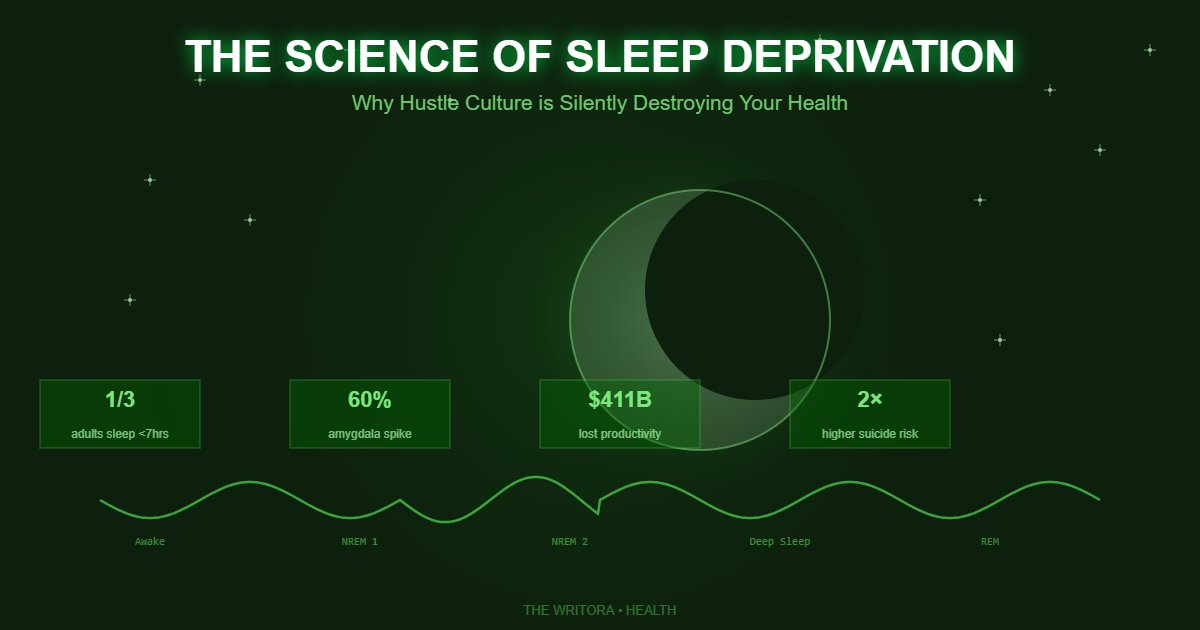
In boardrooms, on social media, and in startup folklore, sleep deprivation has been perversely glamorized. "I'll sleep when I'm dead," goes the famous Silicon Valley maxim. The irony is that chronic sleep loss may be actively accelerating that outcome. The U.S. Centers for Disease Control and Prevention (CDC) identifies insufficient sleep as a public health epidemic, with more than a third of American adults regularly sleeping less than the recommended seven hours per night.
The consequences are not abstract. They are measurable, physiological, and in many cases irreversible. Yet the cultural narrative continues to position sleeplessness as a virtue — a marker of dedication, ambition, and toughness. The science tells a very different story.
What Happens Inside a Sleep-Deprived Brain
Sleep is not idle time. It is when the brain performs critical maintenance. During the deep stages of sleep, the glymphatic system — a waste-clearance network in the brain — flushes out toxic proteins including beta-amyloid and tau, the same proteins that accumulate in the brains of Alzheimer's patients. Research funded by the National Institutes of Health (NIH) has demonstrated that even a single night of poor sleep leads to a measurable increase in beta-amyloid buildup — a finding with profound implications for long-term cognitive health.
Sleep is also the time when memories are consolidated. During REM sleep, the hippocampus replays and transfers information to the neocortex for long-term storage. Sleep deprivation disrupts this process, impairing learning, decision-making, and emotional regulation. Studies at UC Berkeley have shown that after 24 hours without sleep, the amygdala — the brain's threat-detection center — becomes 60% more reactive to negative stimuli, essentially mimicking the neural patterns seen in anxiety disorders.
The Body Under Siege: Physical Health Consequences
The damage from chronic sleep loss extends far beyond the brain. The Sleep Foundation documents a cascade of physical consequences tied to insufficient sleep, including elevated blood pressure, dysregulated blood sugar, systemic inflammation, and suppressed immune function.
Cardiovascular risk is particularly striking. A large-scale study published in the European Heart Journal tracking over 400,000 participants found that people sleeping fewer than six hours per night had a 20% higher risk of heart attack compared to those sleeping seven to nine hours. The mechanism involves elevated cortisol levels, increased arterial inflammation, and disruption of the autonomic nervous system's regulation of heart rate and blood pressure.
Metabolic consequences are equally severe. Sleep deprivation drives up levels of ghrelin — the hunger hormone — while suppressing leptin, the satiety signal. The result is increased appetite, cravings for high-calorie foods, and reduced metabolic efficiency. The World Health Organization notes that obesity rates in countries with high rates of sleep deprivation are consistently elevated, and epidemiological studies confirm the dose-response relationship: the fewer hours slept, the higher the body mass index tends to be.
Mental Health: The Hidden Epidemic Within the Epidemic
The relationship between sleep and mental health is bidirectional and deeply entangled. Depression disrupts sleep; sleep deprivation accelerates depression. Anxiety fragments sleep; fragmented sleep intensifies anxiety. For millions of people, this feedback loop becomes a trap that neither willpower nor self-discipline can break without addressing the underlying biology.
The National Institute of Mental Health (NIMH) recognizes sleep disturbance as both a symptom and a causal factor in major depressive disorder. Emerging research suggests that treating sleep problems directly — through cognitive behavioral therapy for insomnia (CBT-I) rather than through medication — can significantly improve depressive symptoms even in patients who have not responded well to antidepressants.
Suicide risk is another dimension of this crisis that is rarely discussed in the context of sleep. Studies have found that people with insomnia are more than twice as likely to experience suicidal ideation as good sleepers, independent of other psychiatric diagnoses. The relationship holds even after controlling for depression, suggesting that sleep deprivation itself has direct neurobiological effects on mood regulation and impulse control.
The Productivity Paradox of Hustle Culture
Perhaps the greatest irony of hustle culture is that it is counterproductive by its own metric. The same leaders who boast about four-hour sleep schedules are almost certainly performing far below their potential — they are simply too impaired to recognize the gap.
Research by Harvard Medical School published in the Harvard Business Review estimated that sleep deprivation costs U.S. employers approximately $411 billion annually in lost productivity. Cognitive impairment from insufficient sleep affects focus, creative problem-solving, working memory, and emotional intelligence — precisely the skills that knowledge workers rely on most.
Studies by the RAND Corporation found that workers sleeping less than six hours per night are 13% less productive than those sleeping eight hours. Beyond a certain threshold, the impaired person loses the ability to accurately assess their own impairment — a phenomenon known as "sleep debt blindness" that makes self-correction nearly impossible without external accountability.
What the Science Recommends
The American Academy of Sleep Medicine (AASM) and the Sleep Research Society jointly recommend that adults aged 18-60 sleep at least seven hours per night on a regular basis to promote optimal health. Yet fewer than two-thirds of adults in developed nations meet this threshold consistently.
The good news is that sleep is highly responsive to behavioral intervention. Maintaining a consistent wake time seven days a week, limiting blue light exposure in the evening, keeping the bedroom cool and dark, avoiding alcohol within three hours of bedtime, and reducing caffeine after midday are all evidence-based strategies with measurable impact on sleep quality and duration.
For those with clinical insomnia, Cognitive Behavioral Therapy for Insomnia (CBT-I) has a strong evidence base and is now recommended as a first-line treatment ahead of sleep medication. Digital CBT-I programs have expanded access considerably, making this gold-standard treatment available without a clinic visit.
Reclaiming the Night
The cultural glorification of sleeplessness is, at its core, a form of collective self-harm. No serious scientist, physician, or performance researcher advocates for chronic sleep restriction. The evidence is in, and it is overwhelming: sleep is not a luxury, a weakness, or a waste of time. It is the foundation upon which every other dimension of health, performance, and wellbeing rests.
The truly high performers are not those who sleep less. They are those who take sleep seriously enough to protect it.