
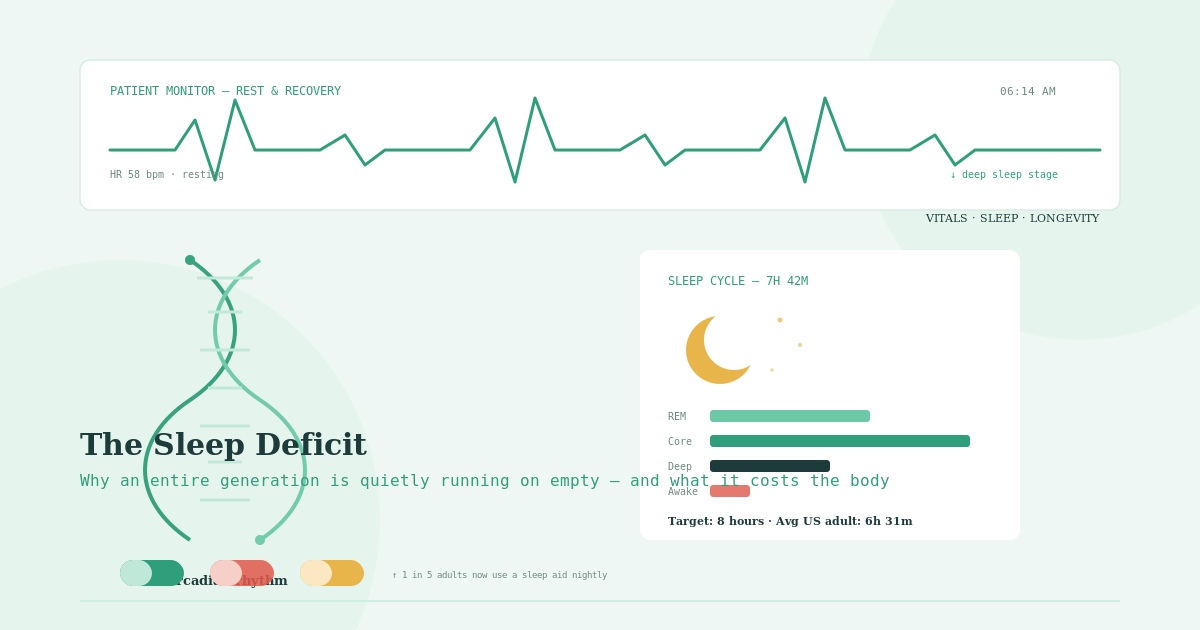
A Quiet Epidemic Hiding in Plain Sight
Somewhere between the late-night scroll and the early alarm, an entire generation has quietly stopped sleeping enough. It rarely makes headlines the way an outbreak or a famine does, yet the numbers describe something just as serious: according to the Centers for Disease Control and Prevention, more than a third of American adults regularly get less than the recommended seven hours of sleep a night. This is not a personal failing — it is a structural one. Work schedules, blue light, anxiety, caffeine, and a culture that treats exhaustion as a badge of honor have combined to produce what researchers now call a public health crisis hiding behind closed eyelids.
What Actually Happens When You Don't Sleep
Sleep is not simply "downtime." During deep sleep, the brain runs a kind of nightly maintenance cycle: clearing metabolic waste, consolidating memories, and regulating hormones that control hunger, mood, and stress. The National Heart, Lung, and Blood Institute notes that chronic sleep deprivation is linked to higher risks of obesity, heart disease, diabetes, and depression. Lose enough sleep for long enough, and the damage compounds quietly — a foggy morning becomes a foggy decade, a single missed night becomes a chronic deficit the body never fully repays.
Cognitively, the effects show up almost immediately. Reaction times slow to levels comparable with intoxication, working memory falters, and emotional regulation weakens — which is part of why sleep-deprived people are more prone to irritability, poor decisions, and conflict. Researchers at the Sleep Foundation describe this as a kind of "cognitive debt" that accumulates faster than most people realize, and is far harder to repay than a single weekend of catching up.
Why We Stopped Prioritizing Rest
The causes are tangled, but a few stand out. Screens emit blue light that suppresses melatonin, the hormone that signals the brain it's time to wind down. Remote and hybrid work have blurred the line between "on" and "off," so the workday increasingly bleeds into the night. And there's a cultural undercurrent that treats sleep as optional — something ambitious people supposedly don't need. That belief is not just wrong; it's expensive. A landmark RAND Corporation analysis estimated that sleep deprivation costs the U.S. economy up to $411 billion a year in lost productivity — roughly 2.28% of GDP — driven largely by absenteeism, reduced output, and avoidable health costs.
Shift workers, new parents, students, and caregivers face the steepest climb, often for reasons beyond their control. But even people with relatively flexible schedules report sacrificing sleep for "one more episode," "one more email," or "one more scroll" — a pattern behavioral scientists have started calling revenge bedtime procrastination: staying up late to reclaim a sense of personal time that the day never allowed.
The Slow Repair: What Actually Helps
The good news is that sleep responds quickly to changed habits — often faster than diet or exercise routines do. Sleep clinicians consistently point to a small set of practices with outsized effects: keeping a consistent wake-up time (even on weekends), dimming screens an hour before bed, avoiding caffeine after early afternoon, and treating the bedroom as a place reserved for rest rather than work or scrolling. The National Institute of General Medical Sciences emphasizes that aligning daily routines with the body's natural circadian rhythm — rather than fighting it — produces the most durable improvements.
For people with persistent insomnia, cognitive behavioral therapy for insomnia (CBT-I) has emerged as the most evidence-backed intervention, often outperforming medication in long-term studies and carrying none of the dependency risks. It is, in essence, a structured way of retraining the mind and body to associate the bed with sleep again — a skill that modern life has slowly eroded.
Rest as Infrastructure, Not Indulgence
Reframing sleep — not as a luxury squeezed in around "real" priorities, but as the biological infrastructure that makes everything else possible — may be the most important shift of all. A well-rested brain learns faster, regulates emotion better, and makes sounder decisions; a poorly rested one runs in survival mode, reacting rather than reasoning. The fix doesn't require a radical overhaul of modern life — just a willingness to treat sleep as seriously as we treat deadlines. Until that shift happens broadly, the quiet epidemic will keep accumulating, one missed hour at a time, in bedrooms that never quite go dark.