In March 2020, when offices around the world closed within the space of a fortnight, most business leaders assumed the disruption would last weeks. Some budgeted for a few months. Almost none planned for a structural reorganisation of how work itself is organised.
Five years later, the data tells a clear story. Remote and hybrid work have not faded with the pandemic that catalysed them. They have stabilised as a permanent feature of the global economy — a shift in scale, expectation, and labour market power that is still working its way through businesses, cities, real estate markets, and individual careers.
Where Things Actually Stand
The numbers from 2025 are worth stating clearly, because they are frequently misrepresented in both directions — by those who claim remote work is disappearing under corporate RTO pressure, and by those who claim it is still expanding.
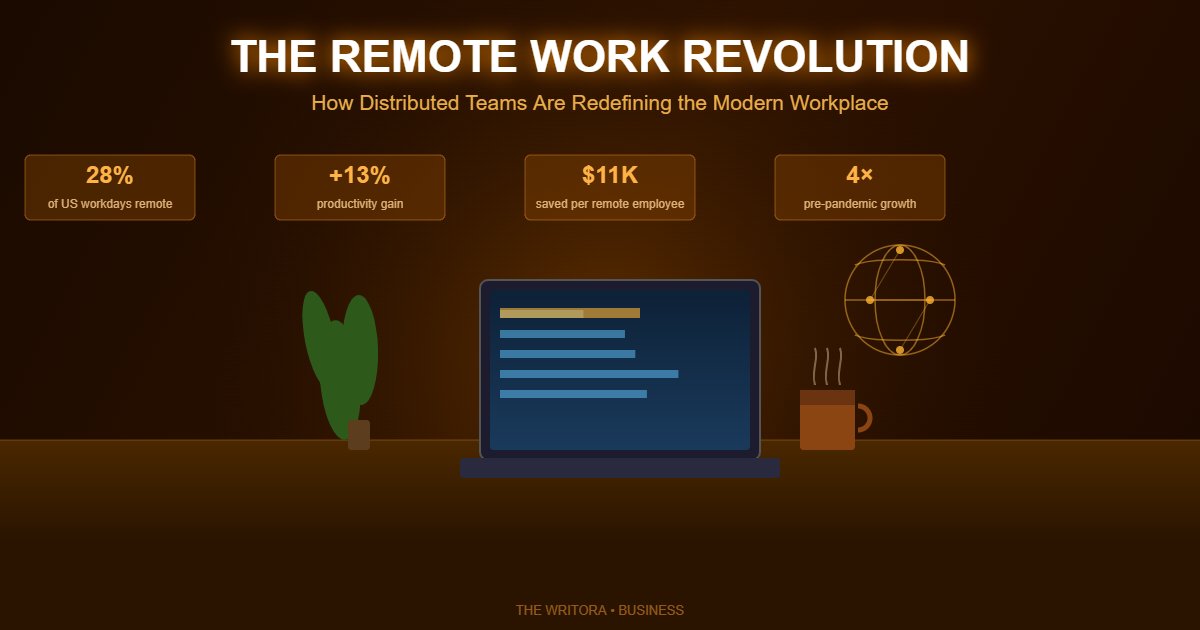
According to research compiled by WFH Research, approximately 29% of all paid workdays in the United States were worked from home in June 2025 — a figure that has held remarkably steady since early 2023, despite the wave of high-profile return-to-office mandates from major corporations. The pre-pandemic baseline was 6.5% of private sector workers working primarily from home. That figure has not returned, and Stanford economist Nicholas Bloom, whose research has tracked remote work more rigorously than almost anyone else, has argued that high-profile RTO announcements would reduce the overall share of remote working days by only about 0.5% — a rounding error in the broader trend.
Approximately 32.6 million Americans work remotely in some capacity in 2025, according to Bureau of Labor Statistics data — around 22% of the total workforce, compared to 6.5% before the pandemic. Among workers whose jobs can be performed remotely, Gallup finds that 51% are now in hybrid arrangements, 28% are fully remote, and only 21% are fully on-site. Only 6% of US employees say they want to work in the office full time.
Globally, the picture is similar. A 40-country survey by the Global Survey of Working Arrangements found that English-speaking countries lead the world in remote work adoption, with hybrid arrangements now standard practice for knowledge workers. In contrast, Asian economies — where cultural norms around office presence remain stronger — have seen significantly less adoption.
The Business Case: Three Calculations
For employers, the remote and hybrid work calculation has three primary dimensions: talent access, real estate costs, and productivity. The evidence on each has matured considerably since the chaotic experiments of 2020.
Talent access is the most transformative advantage, and the one that has most permanently altered how organisations think about hiring. A company based in any city can now credibly hire the best person for a role regardless of where that person lives — without establishing legal entities in new jurisdictions, thanks to the growth of employer-of-record services. Remote.com's Global Workforce Report found that 62% of HR leaders planned to hire internationally in 2024, up from 38% in 2021. The geographic constraint on talent access — one of the most significant limitations on organisational capability in the pre-pandemic world — has substantially weakened.
Real estate savings are substantial and increasingly well-documented. Global Workplace Analytics estimates that a typical employer saves approximately $11,000 per year for every employee who works remotely half the time. For organisations employing thousands of people, the arithmetic produces savings that can be reinvested in talent, technology, or simply returned to shareholders. The commercial real estate market in major cities reflects this calculation: office vacancy rates in central business districts of cities including San Francisco, Chicago, and London remain at historic highs as organisations right-size their physical footprints for hybrid workforces.
Productivity has been the most contested dimension, and the honest answer is that it depends. Bloom's original Stanford research found that remote workers were 13% more productive than their office-based counterparts — but that was in a specific context (call centre workers) with easily measured output. Subsequent research has produced a more differentiated picture. A Trip.com study found zero performance difference between hybrid and fully in-office workers, with significant cost savings from reduced turnover. McKinsey found that well-organised hybrid teams were approximately 5% more productive than alternatives.
The emerging consensus is that productivity outcomes depend heavily on job type, management quality, and the quality of the remote setup. For tasks requiring deep focus and individual contribution — writing, coding, analysis — remote work often outperforms the office. For tasks requiring intensive real-time collaboration, mentorship of junior employees, and the spontaneous creative friction of physical proximity, the office retains advantages that are difficult to replicate digitally.
The Labour Market Shift
From the perspective of workers, remote and hybrid work have fundamentally altered the negotiating dynamics of the labour market — and the effects have been uneven in ways worth understanding.
The preference data is clear. Owl Labs' State of Hybrid Work 2025 found that remote and flexible work were among the top factors influencing professional decisions. 55% of fully in-person employees say they would accept a pay cut — averaging around 11% — in exchange for permanent hybrid or remote work. Among tech workers, some surveys find willingness to accept up to 25% lower salaries for fully remote roles. These are not trivial preference signals. They represent a revealed value that workers place on flexibility that employers have been slow to fully price.
Robert Half's research shows that remote and hybrid job postings attract significantly more applicants than equivalent in-office roles — an advantage that has made remote-eligible positions simultaneously more desirable and more competitive. For job seekers, this means that a remote-eligible role may offer genuine career advantages in talent access and flexibility while also being harder to land than a comparable office-based position.
Geographic arbitrage has emerged as one of the more significant economic consequences of the remote work shift. Workers earning salaries benchmarked to expensive urban labour markets — New York, San Francisco, London, Sydney — while living in lower-cost cities or countries can achieve substantially higher purchasing power. Cost-of-living data from Numbeo shows that a salary sufficient for a comfortable life in San Francisco can support a genuinely affluent lifestyle in more than 80 cities worldwide. This is not a niche strategy. It has become standard practice among software engineers, financial analysts, and professional services workers who have identified geographic flexibility as a negotiable employment benefit.
The RTO Backlash and What It Revealed
Since 2023, a significant number of large employers have attempted to reverse the remote work trend. Amazon mandated five days per week in the office from early 2025. JPMorgan, Disney, and Goldman Sachs have all pushed for more office attendance. The results have been instructive about the limits of corporate authority in a transformed labour market.
BambooHR's research found that 25% of employees who voluntarily left jobs in 2023 cited return-to-office mandates as a contributing factor. Among highly compensated technology and knowledge workers — precisely the employees with the most bargaining power and the most alternatives — resistance to mandatory office attendance has been particularly strong. Several organisations experienced measurable increases in voluntary attrition following RTO announcements, disproportionately affecting the senior, experienced employees who are most expensive to replace.
The deeper issue that RTO mandates revealed is that office attendance and productivity are not as tightly correlated as the managers advocating for returns tend to assume. The data on productivity under hybrid arrangements does not provide strong support for mandating more office days. What it does reveal is a preference among some leaders for the visibility and control that physical presence provides — a preference that employees with remote-capable jobs and market alternatives are increasingly unwilling to subsidise with their commute time.
Federal employment has produced the most dramatic RTO story of 2025. The share of federal employees teleworking fell from 31.3% in April 2024 to 18.2% a year later, with 46% now fully on-site — more than double the national average for knowledge workers. Whether the forced return of federal workers to offices produces the productivity improvements its advocates predicted will be one of the most closely watched natural experiments in remote work research.
The Challenges That Are Real
The case for remote and hybrid work is strong. So are the challenges, and organisations that ignore them have paid for the oversight.
Culture transmission is the challenge most frequently cited by senior leaders, and with reason. The informal interactions that transmit organisational values — hallway conversations, spontaneous lunches, reading non-verbal cues in meetings, the social texture of shared physical space — do not translate naturally to digital environments. Companies like GitLab and Automattic, which have operated as fully remote organisations for years, have invested heavily in documentation-first cultures, asynchronous communication norms, and annual in-person gatherings to compensate. GitLab's Remote Work Playbook, freely available online, has become an industry reference for how to build coherent culture in distributed teams — and is worth reading by any organisation navigating this problem.
Onboarding is another genuine friction point. Research published in the Harvard Business Review found that remote hires take significantly longer to reach full productivity and report lower levels of social integration than in-office counterparts. The first 90 days of employment — when new hires are forming the relationships and absorbing the implicit knowledge that anchor them to an organisation — are particularly vulnerable to the isolation of remote work. Organisations that have solved this problem have typically done so through structured mentorship, intensive early-career in-person time, and deliberate social investment in new employees.
Employee isolation and digital fatigue are real and consistent findings across multiple surveys. The assumption that remote work is universally positive for wellbeing is not supported by the data. Approximately 37% of fully remote employees report that their online activity is monitored by their employer — rising to nearly 50% for hybrid workers — a dynamic that can erode the autonomy that makes remote work attractive in the first place.
Gen Z's unexpected preference for in-person work is worth noting. Despite being digital natives, workers aged 16–24 have the lowest remote work adoption rate of any age group at just 6%, and 91% of Gen Z workers report valuing in-person collaboration for professional growth. The cohort that will define the future of the workforce has more mixed feelings about fully remote work than the generation above them — a data point that organisations planning their long-term workplace strategies should take seriously.
Where the Market Is Moving
The trajectory of the labour market in 2025 and 2026 suggests a stable equilibrium rather than a continued shift in either direction.
Robert Half's analysis shows that 24% of new job postings in Q2 2025 were hybrid and 12% were fully remote — with the hybrid share having nearly doubled since 2023 while the fully on-site share has steadily declined. Platforms dedicated to remote job listings — including We Work Remotely, RemoteOK, and FlexJobs — continue to grow in both listings and traffic, reflecting sustained demand on both sides of the market.
The sectors with the most remote job availability remain technology (44% of positions offering hybrid or remote options), followed by marketing, finance, legal, and increasingly healthcare through telehealth. Entry-level positions offer less flexibility than senior ones: 28% of senior roles are hybrid compared to 13% of entry-level roles — a pattern that reflects both the nature of work at different career stages and the greater bargaining power of experienced workers.
The New Normal
The remote work genie is not returning to the bottle. The workers who experienced the autonomy, the recovered commute time, and the flexibility of location-independent work are not surrendering those gains quietly — and they have demonstrated, through labour market behaviour, that they are willing to change employers, accept lower nominal salaries, or move geographically to preserve them.
The organisations that have navigated this transition most successfully are those that have treated it as a genuine management challenge requiring deliberate solution, rather than either uncritically embracing full remote work or stubbornly resisting any flexibility. The evidence consistently shows that the right arrangement depends on industry, job function, team composition, and the specific nature of the work. What the evidence does not support is the idea that mandatory full-time office presence produces better outcomes for most knowledge workers — or that any organisation can successfully mandate its way back to 2019.
The future of work is hybrid. It is not uniform, not simple, and not finished negotiating.
Has remote or hybrid work changed your career, your lifestyle, or your relationship to work itself? Share your experience in the comments below.