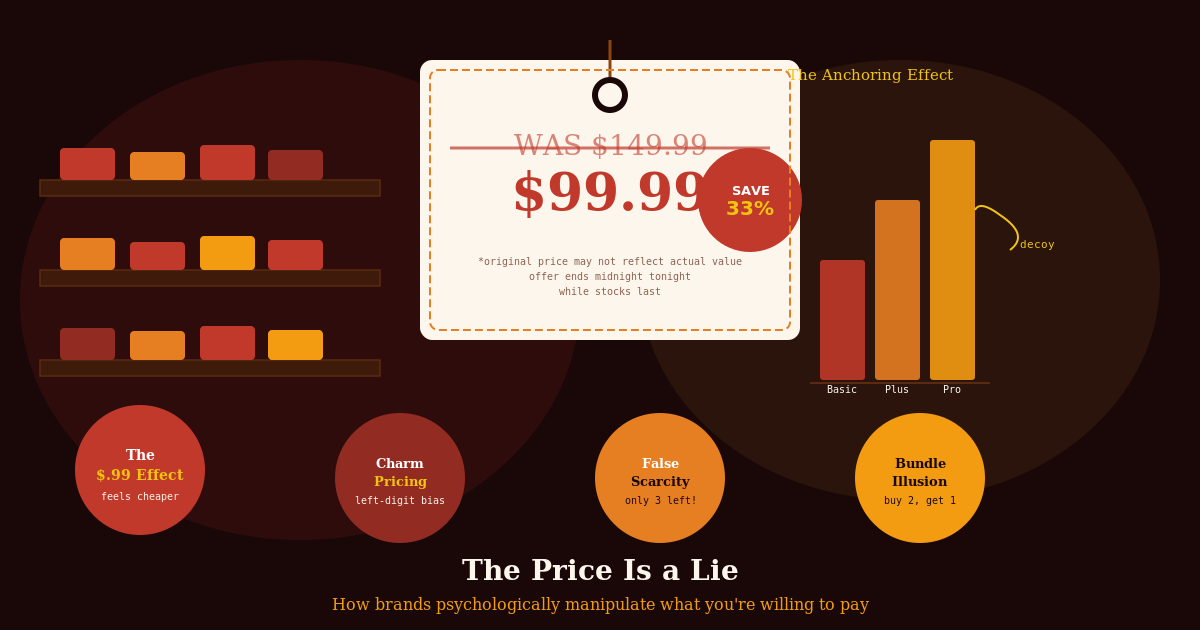
Walk into any supermarket, open any shopping app, browse any e-commerce site, and you will be surrounded by numbers. Prices on shelf tags, prices crossed out and replaced with lower ones, prices presented in three tiers so the middle option feels obvious. None of this is accidental. Behind every number you see is a discipline — part psychology, part economics, part neuroscience — refined over decades of research and billions of transactions.
Welcome to the science of pricing. And it knows you better than you know yourself.
This is not a guide to making better purchases, though it might help with that. It is an explanation of how the pricing systems you encounter every day actually work — how they are designed to short-circuit your rational judgment before you have a chance to apply it, and why even knowing the tricks does not make you fully immune to them.
The Left-Digit Effect: Why $9.99 Feels So Different from $10
Charm pricing — ending prices in .99 — is one of the most thoroughly documented phenomena in consumer psychology, and one of the most counterintuitive. A product priced at $9.99 reliably outsells the same product at $10.00, even though the actual difference is one cent. For decades, researchers assumed this was a simple association with sales and discounts. The deeper explanation turns out to be neurological.
The human brain processes multi-digit numbers sequentially, from left to right, and encodes magnitude based primarily on the first digit encountered. Research published in the Journal of Consumer Research shows that we register $9.99 as nine dollars and something before we have consciously processed the rest of the number. The perceived magnitude is anchored to the leftmost digit — the nine — and the cents are processed as relatively minor detail.
The result is a consistent and measurable distortion. In studies by MIT and the University of Chicago, the same item of clothing tested at $34, $39, and $44 sold best at $39 — not the cheapest price. The nine was more powerful than the lower absolute cost.
What makes this particularly striking is that the effect persists even in people who understand it. Knowing the trick does not make you immune. The left-digit effect operates below the threshold of conscious awareness, engaging cognitive shortcuts that evolved long before anyone invented decimal pricing.
Anchoring: The Power of the First Number You See
In 1974, psychologists Amos Tversky and Daniel Kahneman published a paper in Science that would eventually help earn Kahneman a Nobel Prize. They had discovered anchoring — our tendency to rely disproportionately on the first piece of numerical information we encounter when making subsequent estimates.
In one famous demonstration, participants were shown a randomly spun wheel landing on either 10 or 65, then asked to estimate the percentage of African countries in the United Nations. The random number had a pronounced effect on their answers, even though it was obviously irrelevant. People anchored to the number they had seen and adjusted from there — insufficiently.
In pricing, this effect is weaponised with precision. When you see a coat marked "was $400, now $180," the $400 is not informational. It is an anchor. Your brain uses it to set a reference point, and the $180 is then evaluated not on its own terms — is this objectively good value for a coat? — but relative to the anchor you have been given. The $400 makes $180 feel like a bargain, regardless of whether $400 was ever a genuine price anyone paid.
Retailers understand this so well that the practice of setting artificially high "original" prices specifically to create anchoring discounts has become standard practice — and the subject of consumer protection litigation in multiple countries. The anchor, in many cases, was always a fiction.
Dan Ariely's research at MIT demonstrated that anchoring affects not just how we evaluate prices but what we are willing to pay. In one study, participants were asked whether they would pay a dollar amount equal to the last two digits of their social security number for various consumer goods — a number that is obviously random and irrelevant. People with high-ending social security numbers consistently reported higher willingness to pay than those with low-ending numbers. A random, meaningless anchor had shifted their sense of value.
The Decoy Effect: An Option You Were Never Meant to Choose
Imagine a streaming service with two subscription tiers: Basic at $8 per month and Premium at $15. Most customers will feel the tension between price and features and make a considered choice.
Now add a third tier: Standard at $14 per month — almost as expensive as Premium but with fewer features than Premium and more than Basic. Almost nobody chooses Standard. But Standard was never designed to attract customers. It was designed to make Premium look like exceptional value by comparison.
This is the decoy effect, documented extensively by Dan Ariely and others. A clearly inferior option, strategically placed beside the option you are meant to choose, dramatically increases that option's appeal. The effect works because human beings do not evaluate options in absolute terms. We evaluate them relative to the alternatives on offer — and we can be manipulated by what alternatives are presented.
Ariely demonstrated this with The Economist's subscription pricing. When the magazine offered online-only access for $59 and print-plus-online for $125, most subscribers chose the cheaper option. When they added a print-only option at $125 — the same price as print-plus-online, but clearly worse — something interesting happened. Suddenly, print-plus-online looked like an extraordinary deal. It was the same price as something obviously inferior, which made it feel almost free. Subscriptions to the more expensive package increased dramatically.
The decoy was never meant to sell. It was meant to sell something else.
Scarcity and Urgency: Manufacturing Pressure
Only 3 left in stock. Sale ends midnight tonight. 12 people are viewing this right now.
These phrases are not informational. They are psychological interventions, designed to trigger a specific cognitive mechanism: loss aversion.
Kahneman and Tversky's research established that the pain of losing something is roughly twice as intense as the pleasure of gaining something equivalent. Losing $100 feels significantly worse than winning $100 feels good. This asymmetry means that framing a decision as the potential loss of an opportunity — rather than as the potential gain of a purchase — increases the emotional pressure to act.
Research published in Frontiers in Psychology confirms that scarcity cues shift the decision-making frame from "do I want this?" to "can I afford to miss it?" — a subtle but significant shift that bypasses the rational evaluation of whether the item represents genuine value.
Amazon's product pages have been studied extensively as examples of engineered urgency. "Only 4 left in stock — order soon" appears even on items with consistent inventory. Booking.com's "8 people viewed this in the last hour" creates social proof and scarcity simultaneously. These cues are A/B tested rigorously, and the versions that produce the most immediate purchases are the ones that survive.
The scarcity may sometimes be genuine. Often, it is manufactured. The psychological pressure it creates is real either way.
Bundling: Why You Pay for What You Do Not Want
Mobile phone contracts that include streaming services you never use. Software packages that bundle features you have never opened. Airline seats that include luggage allowances, meals, and lounge access at a combined price that feels reasonable until you calculate the individual components.
Bundling — selling multiple products or services at a combined price — is one of the most effective tools in the pricing arsenal, and research from Harvard Business School explains why: it systematically reduces consumers' ability to evaluate value accurately.
When you evaluate a bundle, you are making a single judgment about a complex package. When you evaluate individual items at individual prices, you apply a separate, often more critical judgment to each. Bundling takes advantage of the fact that the first kind of evaluation is easier, faster, and less demanding — which means it is also less likely to identify poor value.
Subscription services have refined this to an art. The monthly fee feels small. The annual cost, divided by the services you actually use versus the ones included but unused, often tells a different story. Bundling makes the calculation harder to perform — which is precisely the point.
The Psychology of "Free"
Few words in marketing are as powerful as "free." And the reason, according to behavioural economists, is that free is not merely a price point. It is a categorical difference that triggers an entirely different psychological response.
Dan Ariely's experiments on the zero price effect showed that people dramatically overvalue things that are free compared to things that simply cost very little. In one study, participants could choose between a premium chocolate for 15 cents and an ordinary chocolate for 1 cent. Most chose the premium. When the prices were reduced by 1 cent each — making the premium 14 cents and the ordinary free — the majority switched to the free option, even though the relative difference was identical.
Free eliminates the feeling of risk. Free removes the need for calculation. Free triggers acquisition independent of actual desire.
This is why "free shipping on orders over $50" reliably increases average order values: people would rather spend additional money than pay a shipping fee, even when the additional spending exceeds the shipping cost. The irrationality is consistent, predictable, and exploited accordingly.
Dynamic and Personalised Pricing: The New Frontier
The pricing tactics described above are decades old. What is new — and substantially less visible to consumers — is the use of algorithmic pricing that adjusts in real time based on demand, competitor pricing, and increasingly, data about the individual consumer.
Airlines have used dynamic pricing for years. Surge pricing from ride-hailing services brought the model into everyday life. What is happening now is that retailers across sectors are using machine learning to set prices that vary by the time of day, the device you are using, your browsing history, your location, and in some cases, your apparent willingness to pay based on behavioural signals.
The same product, on the same website, can be shown at different prices to different users. This is not illegal in most jurisdictions. It is not always disclosed. And it represents a significant evolution in the power asymmetry between retailers and consumers: they know things about your price sensitivity that you have never consciously communicated.
What You Can Actually Do
Research consistently shows that even people who understand anchoring, the left-digit effect, and loss aversion remain meaningfully susceptible to all three. The effects operate below conscious awareness, and awareness does not fully neutralise them. But there are practical interventions that help.
Set a budget before you browse. The anchor you bring to a shopping session matters as much as the one retailers set. If you have decided in advance what you are willing to spend, you have your own reference point to compete with the one being presented to you.
Compare absolute prices, not percentage discounts. A 50% discount on a $200 item and a 10% discount on a $90 item produce the same saving, but feel very different. Strip away the framing and look at what the item actually costs.
Verify original prices independently. If a "was $400, now $180" claim seems suspicious, look for the product elsewhere. In many cases, the original price is either fabricated or reflects a price that was offered briefly and rarely paid.
Wait 24 hours before significant purchases. Urgency cues are designed to compress the decision window. Extending that window — deliberately removing yourself from the artificial pressure — restores the space for rational evaluation.
Unbundle before you buy. For any subscription or package deal, calculate what you are actually paying for the components you will use. The components you will not use are not free just because they are included.
Research confirms that these defences do not eliminate susceptibility. But they meaningfully reduce it — and in a world where the pricing systems you encounter have been optimised by teams of behavioural scientists with access to billions of data points, a meaningful reduction is worth pursuing.
The price you see is a message crafted carefully, tested rigorously, and aimed directly at the part of your brain that decides before you know it has. The least you can do is read it with a great deal more scepticism than it was designed to receive.
Have you caught yourself falling for one of these pricing tactics? Share your experience in the comments below.