
Oceans on Fire
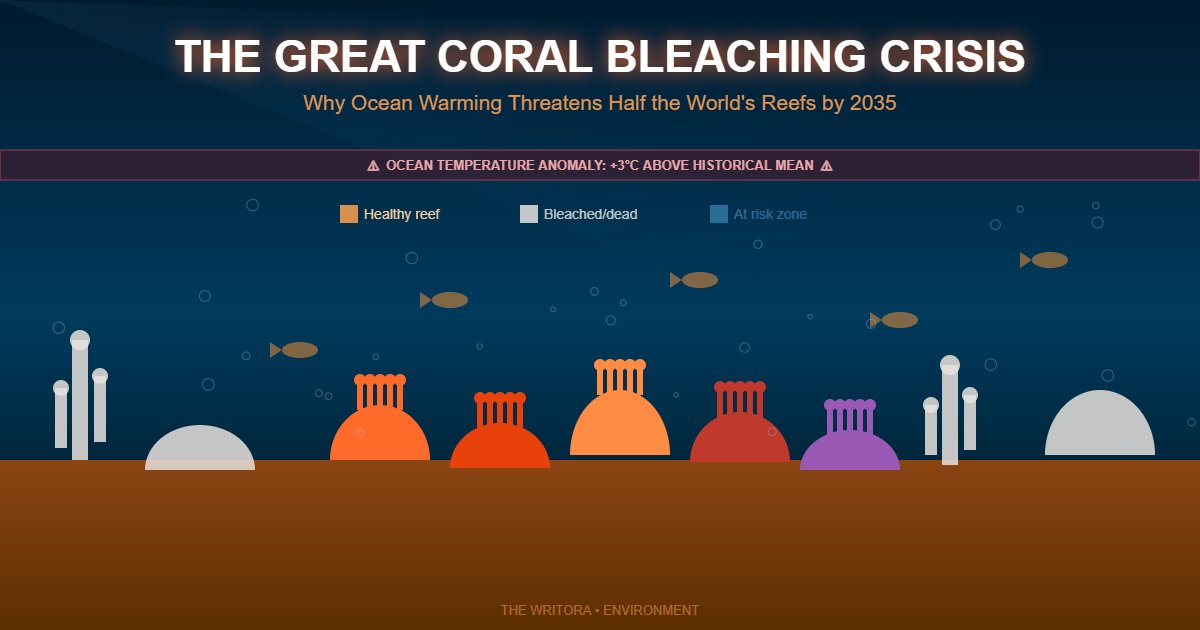
In 2024, the world's oceans reached temperatures that stunned even veteran climate scientists. The European Union's Copernicus Climate Change Service recorded the highest global average sea surface temperatures in the instrumental record, with some regions running more than 3°C above the historical mean — an extraordinary anomaly that sent shockwaves through the marine science community.
The consequences for coral reefs have been catastrophic. Corals are exquisitely temperature-sensitive organisms. A sustained increase of just 1°C above the summer maximum is enough to trigger bleaching — the process by which corals expel the symbiotic algae (zooxanthellae) that give them both color and up to 90% of their energy. Without those algae, corals turn white and begin to starve. If temperatures do not return to normal within weeks, they die.
The Fourth Global Bleaching Event
NOAA's Coral Reef Watch confirmed in early 2024 that the world was experiencing its fourth mass coral bleaching event in recorded history — and the most severe. The previous three events occurred in 1998, 2010, and 2014–2017. Each was considered unprecedented at the time. This one dwarfs them all in geographic scale, affecting reefs across the Pacific, Atlantic, and Indian Oceans simultaneously.
Australia's Great Barrier Reef — the world's largest coral reef system, spanning over 2,300 kilometers — has now experienced five mass bleaching events since 1998, with the 2024 event affecting the broadest area ever recorded. The Australian Institute of Marine Science (AIMS) reported bleaching across more than 73% of surveyed reefs in 2024, a figure that would have seemed unthinkable to scientists two decades ago.
In the Florida Keys, researchers documented near-total bleaching across inshore reefs in 2023, with water temperatures reaching 38°C — hotter than a typical hot tub. Many of those reefs did not recover before the 2024 event arrived.
Why Coral Reefs Matter Far Beyond the Ocean
It is easy to think of coral bleaching as primarily an aesthetic tragedy — the loss of color and beauty from an underwater landscape. The economic and human reality is far starker. The World Wildlife Fund (WWF) estimates that coral reefs provide economic goods and services worth approximately $375 billion each year to millions of people globally.
Over 500 million people depend on coral reefs for food, income, and coastal protection. The fisheries supported by reef ecosystems provide protein for billions across the Indo-Pacific, the Caribbean, and East Africa. Reef structures also act as natural breakwaters, dissipating up to 97% of incoming wave energy and protecting coastlines from storm surge — protection that is particularly critical for low-lying island nations already threatened by rising sea levels.
The medical dimension is less well-known but equally significant. Coral reef organisms have already yielded compounds used to treat cancer, HIV, and cardiovascular disease. NOAA estimates that coral reefs hold more promise for new medicines than any other ecosystem on Earth, yet most species remain unstudied — and many may go extinct before scientists have the chance to examine them.
The Science of Collapse: Tipping Points and Feedback Loops
The trajectory of reef degradation is not linear — it is accelerating. Under current emissions trajectories, the Intergovernmental Panel on Climate Change (IPCC) projects that 70–90% of the world's coral reefs will experience severe bleaching annually at 1.5°C of global warming above pre-industrial levels. At 2°C, that figure rises to 99%.
Bleaching events that once occurred every 25–30 years now recur every 3–5 years. This frequency matters enormously because recovery from bleaching takes at least 10–15 years under ideal conditions. When bleaching events arrive faster than reefs can recover, the ecosystem undergoes a regime shift — from a coral-dominated state to an algae-dominated one. That transition, once complete, is extremely difficult to reverse.
Ocean acidification compounds the threat. As the ocean absorbs CO2, it becomes more acidic, impeding corals' ability to build their calcium carbonate skeletons. Reefs that survive bleaching are thus weakened structurally, making them more vulnerable to the next thermal event, physical damage from storms, and disease.
Can Reefs Be Saved? Interventions and Their Limits
A growing community of marine scientists and conservationists is working to buy time for reefs through direct intervention. Coral gardening programs — in which fragments of surviving coral are grown in nurseries and transplanted onto degraded reefs — have shown promise in the Florida Keys, the Caribbean, and parts of the Indo-Pacific. The Coral Restoration Foundation has planted over 200,000 corals on Florida's reef tract, one of the largest coral restoration efforts in the world.
Assisted evolution — selectively breeding or genetically engineering more heat-tolerant coral strains — represents a more speculative but potentially transformative approach. Researchers at the Australian Institute of Marine Science and the Gates Coral Lab in Hawaii have identified naturally heat-tolerant coral genotypes and are working to propagate them at scale. Some coral populations in naturally warm lagoons in the Pacific appear to have evolved partial thermal tolerance through epigenetic changes — offering a potential blueprint for assisted adaptation.
Shade structures, localized cooling systems, and even cloud-brightening experiments (spraying sea salt into the atmosphere to increase cloud reflectivity and reduce incoming solar radiation) are being tested as emergency interventions for particularly high-value reefs. AIMS has conducted pilot studies of marine cloud brightening near the Great Barrier Reef, though the technology remains years from deployment at meaningful scale.
The Only Real Solution
Every reef scientist interviewed for this article arrived at the same conclusion: restoration and intervention can help, but they cannot save coral reefs at scale without rapid and deep cuts to greenhouse gas emissions. The physiology of coral is simply incompatible with the ocean temperatures that current emissions trajectories will produce by mid-century.
The math is unforgiving. Keeping global warming below 1.5°C — the threshold at which some reefs remain viable — requires halving global emissions by 2030 and reaching net zero by 2050, according to the Paris Agreement targets. Current national commitments put the world on track for roughly 2.7°C — a scenario incompatible with the survival of most coral reef ecosystems as we know them.
The coral reefs of the world are among the oldest and most complex ecosystems on Earth. Some coral structures in the Pacific are thousands of years old. They have survived ice ages, asteroid impacts, and mass extinctions. What they cannot survive — at least not without radical human action — is the rate and scale of warming that industrial civilization has set in motion.
The window to act is not closed. But it is closing faster than the bleaching alerts can keep pace with.