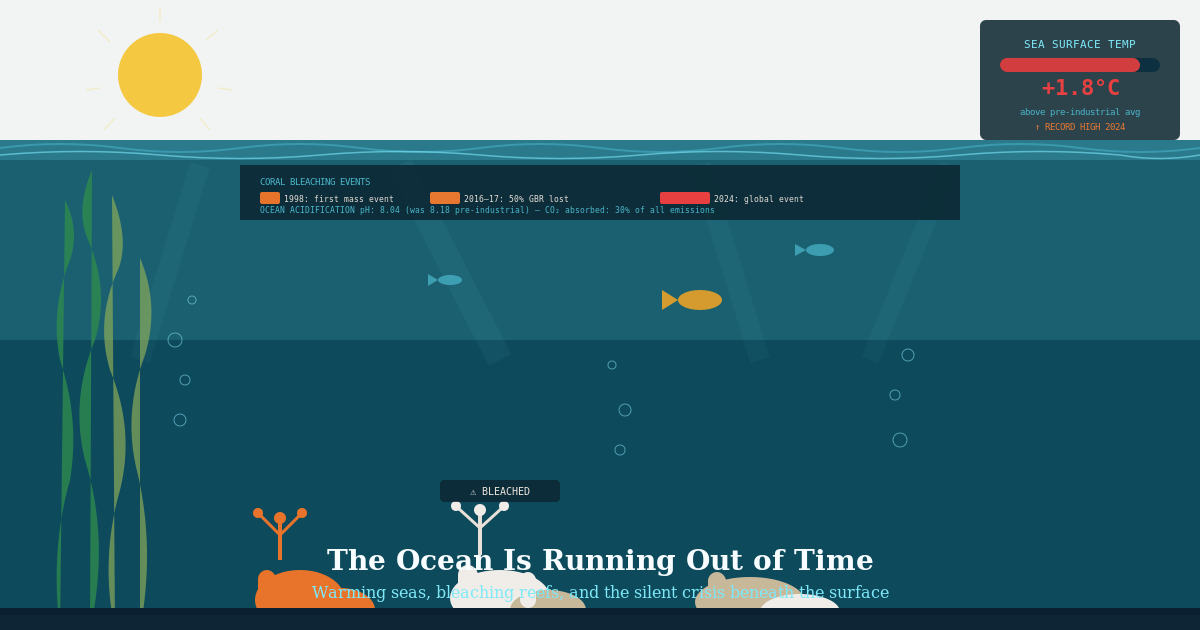
In September 2023, scientists monitoring global ocean temperatures reached a conclusion that stunned even veteran climate researchers. For three consecutive months, sea surface temperatures had broken records that had stood for decades — by margins that the observational record had never seen. Oceanographers writing in Frontiers in Marine Science described the departure from historical norms as "unprecedented." By April 2024, NOAA confirmed that a fourth global mass coral bleaching event had begun — the largest ever recorded, eventually affecting 84% of the world's coral reef area before it concluded in mid-2025.
These are not data points at the edge of scientific concern. They are the centre of it.
This article explains what is happening to the ocean, why it matters to every person on Earth regardless of whether they live near water, and what the latest science tells us about how much time remains to change course.
The Ocean as Climate Infrastructure
To understand why ocean warming is so alarming, you first need to understand what the ocean does.
The ocean covers more than 70% of the Earth's surface and functions as the planet's primary heat regulator. Since industrialisation began, human greenhouse gas emissions have been trapping additional energy in the Earth's climate system — and according to research published in Science, approximately 90% of that excess heat has been absorbed by the ocean rather than remaining in the atmosphere. As NASA's climate science division puts it: without the ocean's buffering function, surface temperatures on land would be catastrophically higher than they are today.
The ocean has, in other words, been absorbing the consequences of industrial civilisation for 150 years. It has been doing this at a significant cost to itself. And the evidence that this buffering capacity is reaching its limits is now visible not just in laboratory models but in satellite imagery, in the bleached skeletons of reefs, and in ocean temperature records that researchers describe as shattering decades of precedent.
What Is Actually Happening to Ocean Temperatures
Sea surface temperatures in 2023 and 2024 ran between 0.5°C and 1°C above any previous record for the equivalent period. To non-specialists, these numbers can sound modest. In climate terms, they represent something extraordinary — the equivalent of decades of normal warming compressed into months.
The anomaly was large enough, and sustained for long enough, that researchers are still working to understand its full causes. The strong El Niño event of 2023–24 contributed, as did the long-term warming trend driven by greenhouse gas emissions. Some researchers have proposed additional factors, including a reduction in reflective aerosols from shipping fuel regulations introduced in 2020, which may have allowed more solar radiation to reach the ocean surface. The science is still being refined.
What is not in dispute is the observed outcome. Ocean heat content — the total amount of thermal energy stored in the ocean — has broken records in each of the past several years. The NOAA Climate.gov monitoring programme estimates that the ocean is now storing approximately 91% of the excess heat energy trapped in the Earth's climate system. And crucially, heat stored in the deep ocean will eventually be released back to the surface — meaning that some additional warming is already committed, regardless of what happens to emissions in the near term.
Coral: The Most Visible Casualty
Coral reefs are to the ocean what old-growth forests are to the land: structures built over millennia that support extraordinary biodiversity, protect coastlines, sustain fisheries, and cannot be quickly rebuilt if destroyed. They cover less than 1% of the ocean floor but support approximately 25% of all marine species.
They are also among the most thermally sensitive ecosystems on Earth.
When water temperature rises as little as 1°C above the seasonal maximum and remains elevated for more than a few weeks, corals expel the symbiotic algae that give them colour and provide them with up to 90% of their energy through photosynthesis. This is coral bleaching — the coral turns white, not because it is dead, but because the algae are gone. Without them, the coral is starving. If the temperature does not return to normal within weeks, the coral dies.
The Great Barrier Reef experienced its first mass bleaching event in 1998. It has since experienced five more. A 2024 study published in Nature found that the frequency of severe bleaching events has increased fivefold since the 1980s, and that the gap between events is now so short that many reefs cannot fully recover between them. The cumulative effect is a permanent reduction in reef health — a slow-motion collapse playing out across decades.
The fourth global bleaching event, confirmed by NOAA in April 2024, was the most extensive ever documented. From early 2023 to mid-2025, bleaching-level heat stress affected 84% of the world's coral reef area across 83 countries and territories. This was not a regional event. It was a global one.
At 1.5°C of warming above pre-industrial temperatures — a threshold the world briefly exceeded as an annual average in 2024 for the first time — the UN's Intergovernmental Panel on Climate Change estimates that 70–90% of the world's coral reefs would be lost. At 2°C, the projection is near-total loss.
Ocean Acidification: The Crisis Nobody Talks About
Coral bleaching is visible. Ocean acidification is not — which is partly why it receives less public attention, and partly why scientists consider it equally alarming as a long-term threat.
When the ocean absorbs carbon dioxide, it reacts with seawater to form carbonic acid. This is basic chemistry, and it has been happening at an accelerating rate as atmospheric CO₂ concentrations have risen. NOAA estimates that ocean pH has declined by 0.1 units since industrialisation. That figure sounds small. Because pH is a logarithmic scale, it represents a 26% increase in the ocean's acidity — the fastest rate of acidification in at least 300 million years of Earth history.
The consequences are already measurable. Shell-forming organisms — oysters, mussels, pteropods (tiny sea snails), and the microscopic organisms that form the base of many marine food webs — struggle to form and maintain their shells in more acidic water. Pteropods, which are a critical food source for salmon, herring, and many seabirds, have been documented with shells that are visibly dissolving in polar waters. At current rates, some polar ocean waters will be corrosively acidic to shellfish larvae by the 2040s.
The concern about acidification is not merely ecological. It is structural. The organisms most affected by acidification are not charismatic megafauna — they are the microscopic and near-microscopic organisms at the base of marine food chains. Destabilising those chains has consequences that cascade upward through every species that depends on them, including the fish that billions of people eat.
Why This Matters to Everyone, Not Just Coastal Communities
The human case for caring about ocean health is not primarily sentimental. It is nutritional, economic, and atmospheric.
More than 3.3 billion people rely on seafood as their primary protein source. For many of the world's poorest and most food-insecure communities — in sub-Saharan Africa, South and Southeast Asia, and the Pacific Islands — fish is not a lifestyle choice. It is a dietary staple that has no affordable alternative. Ocean warming and acidification are already disrupting fish populations, pushing species into cooler waters, reducing breeding success, and affecting the productivity of fisheries that coastal communities have depended on for generations.
Coral reefs directly generate economic value estimated in the hundreds of billions of dollars annually — through fisheries, coastal protection, and tourism. The Great Barrier Reef alone contributes approximately $6.4 billion annually to the Australian economy and supports 64,000 jobs. When researchers talk about reef loss in ecological terms, they are also describing economic losses that will fall disproportionately on countries that can least afford them.
And then there is the atmospheric dimension. The ocean's capacity to absorb carbon dioxide is itself affected by warming and acidification. Warmer water holds less dissolved gas. More acidic water may reduce the productivity of the phytoplankton that absorb carbon through photosynthesis at the ocean's surface. If the ocean's carbon sink weakens — and there is evidence that this is beginning to happen — the trajectory of atmospheric CO₂ concentrations becomes significantly worse than current models project.
The ocean, in short, is not a peripheral concern. It is the central system regulating whether the climate remains within the range in which human civilisation developed.
What the Science Says About the Path Forward
The scientific consensus on what is required is clear, even if the politics of acting on it are not.
Coral reefs cannot be saved by conservation efforts alone. They can be slowed, protected, and in some cases assisted to adapt — but the fundamental driver of their decline is ocean warming, and ocean warming is driven by greenhouse gas emissions. No amount of reef management, however sophisticated, substitutes for reducing the emissions that are raising ocean temperatures.
At the same time, targeted interventions do matter at the margins. Reducing local stressors — water pollution, destructive fishing practices, coastal development that disrupts reef ecosystems — improves reef resilience and gives bleached corals better chances of recovery. Research programmes developing heat-tolerant coral varieties for assisted evolution offer some long-term hope. NOAA's Coral Reef Watch programme, which monitors bleaching risk in near real time from satellite data, is allowing conservation resources to be targeted more effectively.
But the fundamental arithmetic of reef survival is now stark. At current emission trajectories, the ocean will continue warming. Bleaching events will continue to increase in frequency and severity. The gap between events will continue to shorten. The window for meaningful action is not closing — in many respects, for the reefs that have already been lost, it has already closed.
The Time Problem
The ocean operates on timescales that do not match human political cycles. The heat that the ocean has already absorbed will continue to influence sea surface temperatures for decades, regardless of near-term emission changes. The acidification underway cannot be reversed quickly — ocean chemistry changes slowly in both directions. The coral reefs that have died in recent bleaching events will not return within human lifetimes.
This time mismatch is the deepest challenge in ocean climate communication: the decisions that matter most need to be made now, their consequences will not be fully visible for decades, and the most severe impacts will fall on future generations and on communities that have contributed least to the problem.
The ocean has been absorbing the consequences of industrial civilisation for 150 years. The evidence that those consequences are now being returned to the surface — in record temperatures, in bleaching events of unprecedented scale, in acidification that is already affecting marine food webs — is no longer ambiguous.
The bill, as scientists have been saying with increasing urgency for a decade, is coming due. The only question that remains is whether we will act on the evidence while it is still possible to change what comes next.
What aspect of ocean change concerns you most? Share your perspective in the comments below.