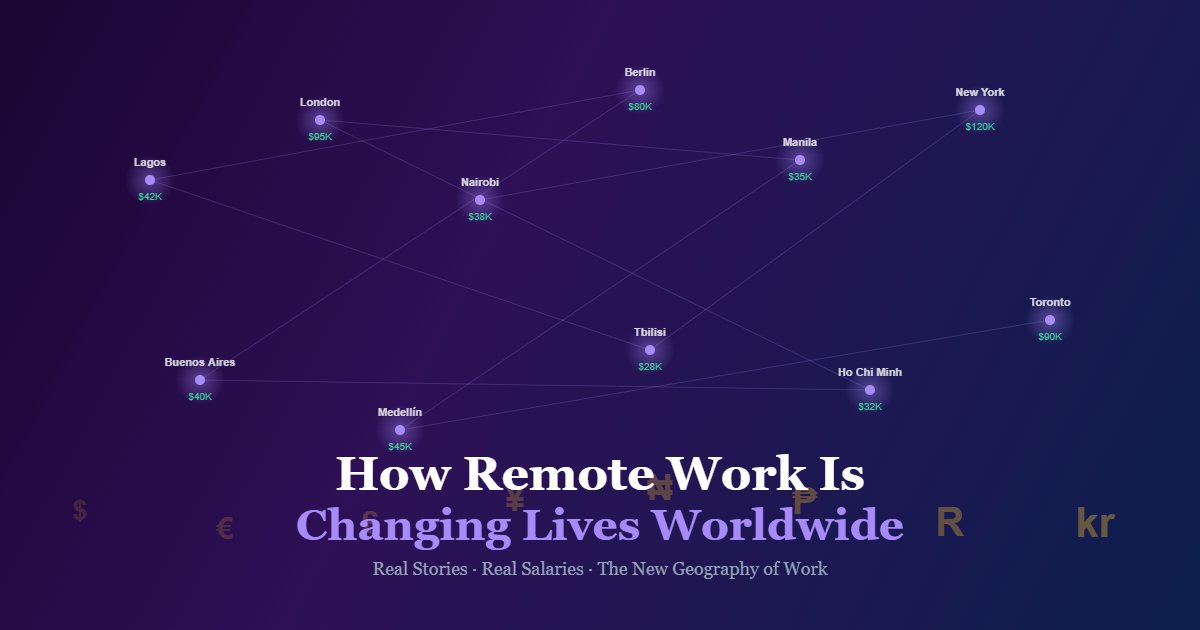
Consider what it means to earn $60,000 a year in the Philippines.
The median annual salary in the Philippines is approximately $5,400. A remote worker earning $60,000 in a US-based customer success role — a salary that feels modest in San Francisco — is earning eleven times the national median while living in a country where a comfortable apartment in a major city costs $300–$500 a month, a restaurant meal costs $3–$8, and private healthcare is high-quality and accessible. The purchasing power multiplier is extraordinary: what a US-based worker needs $150,000 to achieve, their Manila-based counterpart achieves on significantly less.
This dynamic — earning in hard currencies while spending in local ones — has quietly created a new class of economically empowered workers in countries across Africa, Southeast Asia, Latin America, and Eastern Europe. The Payoneer Global Freelancer Income Report has documented strong growth in freelancer earnings across emerging markets, driven primarily by access to clients in the US, UK, Canada, and Western Europe. Workers in Nigeria, Kenya, the Philippines, and Bangladesh consistently rank among the highest-growth earner categories — not because those markets pay more, but because remote work gave workers there access to markets that do.
This is one of the most significant and least covered stories of the remote work era.
Africa's Remote Work Boom
Sub-Saharan Africa is often underrepresented in global remote work conversations, but the numbers tell a different story. Nigeria, Kenya, and South Africa have each developed substantial remote work ecosystems, driven by young populations, improving connectivity, and a generation of workers who recognised early that internet access plus marketable skills equals global earning potential.
Nigeria has emerged as one of the most significant sources of remote freelance talent on global platforms. Nigerian developers, designers, and marketers increasingly compete for — and win — projects from US and European clients. Andela, founded in 2014, built its entire business model around training Nigerian and pan-African software engineers and placing them with US and European technology companies, demonstrating the scale of available talent before the broader remote work market caught up. The National Information Technology Development Agency (NITDA) runs nationwide digital skills initiatives under Nigeria's National Digital Economy Policy and Strategy, formally recognising that remote work access is a development priority, not merely a lifestyle choice.
Payment infrastructure has been a historic barrier, but it is rapidly improving. Platforms including Payoneer, Wise, Flutterwave, and Paystack have emerged specifically to solve the problem of receiving dollar and euro payments in African bank accounts — reducing the friction that previously prevented many African workers from accessing international platforms despite having the skills to compete on them.
Kenya's tech hub in Nairobi — nicknamed Silicon Savannah — has matured into a genuine innovation ecosystem. The city has produced a generation of remote workers with enterprise-grade skills in software engineering, data science, and digital marketing. Coworking spaces have proliferated in Nairobi, Kampala, Accra, and Kigali, creating the professional infrastructure that remote work at this level requires.
South Africa's English proficiency, similar time zones to Europe, and strong educational infrastructure have made it a preferred source for remote customer support, operations, and digital marketing roles at European companies. Cape Town in particular has developed a reputation as a quality-of-life destination that also attracts international remote workers, creating a dual dynamic: South Africans working for foreign employers, and foreign remote workers choosing South Africa as their base.
Southeast Asia's Remote Work Infrastructure
Southeast Asia has the most developed remote work infrastructure of any emerging region, in part because the Philippines established a Business Process Outsourcing (BPO) industry in the 1990s that normalised English-language professional work for global clients decades before the term "remote work" entered mainstream usage.
The Philippines is home to one of the largest concentrations of remote workers globally. Filipino virtual assistants, content writers, social media managers, and customer service professionals serve clients across the US, Australia, and the UK. The combination of strong English proficiency, cultural familiarity with US and Australian markets, a deeply established remote work culture, and significantly lower living costs than Western markets creates a genuine competitive advantage. Numbeo's cost of living data confirms the Philippines as one of the most affordable countries for a comfortable urban lifestyle among major remote work hubs.
The rate disparity between Filipino workers and their Western counterparts is real and meaningful — Filipino professionals typically charge $8–$25 per hour for work that would cost $30–$60 per hour if done by a US-based worker. For Filipino workers, this still represents significant earnings relative to local wages. For clients, it represents substantial cost savings. Understanding this dynamic honestly — without either minimising the economic empowerment it creates or ignoring the structural inequalities it reflects — is essential context for anyone participating in this market.
Vietnam has emerged as a particular hotspot for remote tech work. With a young, highly educated workforce, growing English proficiency among the urban professional class, and a government that actively promotes technology sector development, Vietnamese developers and designers are increasingly sought after by European and North American startups. Ho Chi Minh City and Hanoi have developed dense coworking ecosystems. Toptal — which accepts fewer than 3% of applicants through rigorous vetting — consistently highlights Vietnam as a top source of platform-verified remote developers, a significant indicator of the quality level the market is now producing.
Indonesia, with Bali as its centre of gravity for the global remote work community, plays a dual role: it is simultaneously a destination for international remote workers seeking affordable living and a growing source of remote talent for regional and global employers.
Latin America's Nearshore Advantage
Latin America has a geographical advantage that neither Africa nor Asia can offer to North American employers: time zone alignment. Mexico City, Bogotá, and Buenos Aires all operate within one to three hours of US Eastern time, enabling real-time collaboration, synchronous meetings, and natural communication rhythms that pure asynchronous remote arrangements can struggle to replicate.
This nearshore advantage has driven a surge of US companies — particularly startups and mid-market technology companies — hiring remote engineers, designers, and operations professionals from the region. The result is a hiring model sometimes called "nearshoring" that is distinct from both offshore outsourcing and domestic hiring, and increasingly standard in the growth playbooks of US technology companies.
Colombia has particularly distinguished itself. Medellín's transformation from the city it was in the 1990s to one of Latin America's most innovative technology hubs is one of the remarkable urban development stories of the century. The city's combination of year-round spring-like climate, affordable living costs, reliable modern infrastructure, and vibrant professional community has attracted both international remote workers and companies building distributed teams with Colombian talent. Remote salaries from US employers for Colombian professionals typically run 40–60% of equivalent US rates — still far above local median wages, and sufficient for a high quality of life in the Colombian context.
Argentina presents a different dynamic. Years of economic instability and currency devaluation have made Argentine professionals among the most motivated to earn in foreign currencies — and the country produces engineers, designers, and marketing professionals of high quality who compete effectively on international platforms. The current exchange rate environment means that dollar-denominated earnings provide extraordinary purchasing power in local terms.
Mexico, with its physical proximity to the US and large population of English-speaking professionals, is the most naturally positioned of any Latin American country for nearshore remote work. Major US companies increasingly maintain Mexico City as a genuine operational hub for distributed teams rather than merely an offshore office.
The Platforms Connecting Global Talent to Global Opportunity
The infrastructure for connecting workers in emerging economies with international clients has matured significantly since 2020.
Upwork remains the largest global freelance marketplace, with millions of registered professionals across every geography and skill category. Its transparent review system and payment protection provide a credible starting point for workers new to international freelancing. Competition at entry level is real, but the platform's verified review history becomes a durable credential over time.
Toptal serves the premium end of the market — fewer than 3% of applicants are accepted through its vetting process, but those who pass have access to clients paying premium rates for verified talent.
Remote4Africa has emerged specifically to curate verified remote opportunities for Africa-based talent, reducing exposure to job scams and low-quality listings — a meaningful service in markets where fraudulent listings are a significant problem.
Andela continues to place African technology professionals with international companies, having expanded beyond its original Nigeria focus to cover talent across the continent.
Payment platforms are as important as job platforms for workers in emerging economies. Payoneer has the strongest presence in emerging markets, with local withdrawal options in many countries. Wise offers competitive exchange rates for converting earnings to local currency. Flutterwave and Paystack serve African markets specifically. The ability to receive international payments efficiently — at reasonable exchange rates and without excessive fees — is a practical prerequisite for sustainable international remote work.
Building the Skills That Open the Market
Regardless of geography, the path into the global remote job market follows a common sequence. The barriers that once kept geography as a limiting factor in career development — lack of fast internet, absence of international payment infrastructure, employer scepticism about overseas hiring — have either disappeared or dramatically diminished in most markets. What remains is skills.
The highest-volume remote job categories globally — software development, design, writing, data analysis, digital marketing, customer support, and project management — all have clear, learnable skill sets with accessible training available at low or zero cost.
freeCodeCamp provides free, self-paced training in JavaScript, Python, data analysis, and more, with a curriculum that has produced working developers across the globe. Coursera offers courses and professional certificates from top universities and companies, with financial aid available for learners who cannot afford the subscription. edX provides similar access to structured learning, including the widely-recognised CS50 from Harvard at no cost. The Odin Project is a free, project-based web development curriculum that consistently produces portfolio-ready developers.
The sequence after skills is presence: a polished LinkedIn profile in English, a portfolio of sample work accessible via URL, and profiles on relevant platforms appropriate to your field.
The Broader Picture
The global remote work economy represents something genuinely new in the history of economic development: access to income opportunities that were previously determined entirely by where a person was born. A software developer in Lagos, a designer in Ho Chi Minh City, a content writer in Medellín, and a data analyst in Nairobi now compete in the same talent market as their counterparts in London, New York, and Sydney — and increasingly, they win.
The inequality this creates is real and complex. Workers in the global south earning Western wages exist in a structurally different position from their local counterparts who do not have those opportunities. The rate disparities between emerging market workers and Western workers for the same skills reflect market dynamics, not skill differentials, and those dynamics are themselves a consequence of the same economic inequalities that remote work partially alleviates.
What is not ambiguous is the direction of change. Access to the global remote job market is expanding, the tools for participation are improving, and the number of workers in emerging economies building sustainable, high-income careers through international remote work is growing. The new geography of work is not a finished map. It is still being drawn.
Are you working remotely for international clients or employers from outside a Western country? Share your experience in the comments below.