Something significant has shifted in hiring over the past decade. Between 2017 and 2024, the share of US job postings requiring a four-year college degree dropped from 51% to 44%. Major companies including Google, Apple, IBM, and Salesforce formally removed degree requirements from large portions of their job listings. The Burning Glass Institute's Degree Reset report found that over 7 million jobs were opened to non-degree candidates between 2017 and 2022, and the trend has continued.
The Opportunity@Work nonprofit, which tracks skills-based hiring, estimates that more than 70 million US adults are "skilled through alternative routes" — they have the competencies employers need but have historically been screened out by degree requirements. The Tear the Paper Ceiling campaign, which includes major employers like Walmart, IBM, and Bank of America, represents a formal commitment to skills-first hiring from companies that collectively employ millions.
One important caveat before we go further: research from Burning Glass and Harvard Business School has found that removing degree requirements does not automatically translate into more job offers for non-degree candidates. Some employers have removed the checkbox without changing their actual evaluation process. This matters practically: a non-degree candidate succeeds by making the degree question irrelevant through the strength of their portfolio, certifications, and demonstrated results — not by assuming the policy change alone will open the door.
This guide covers the highest-paying remote roles accessible to non-degree candidates, the certifications that carry real weight with employers, and how to position yourself to actually get hired.
The Highest-Paying Remote Roles Without a Degree
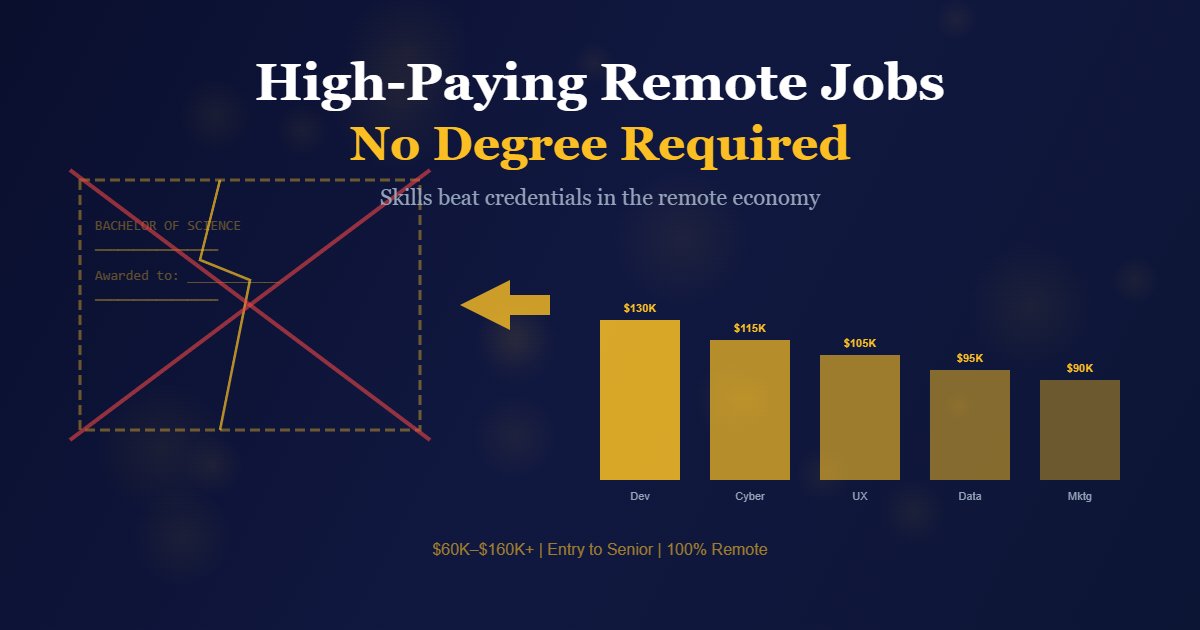
1. Software Developer / Web Developer ($85,000–$160,000+)
Software development has the longest tradition of skills-first hiring of any high-paying field. Its evaluation culture — built on GitHub portfolios, take-home coding projects, and technical interviews — filters on demonstrated ability rather than credential. Self-taught developers and coding bootcamp graduates regularly land roles at competitive salaries, particularly in web development and DevOps.
The most in-demand skills in 2026 include JavaScript and React for front-end development, Python for back-end and data work, and cloud platforms including AWS, Google Cloud, and Azure. The path to these skills is more accessible than it has ever been:
- freeCodeCamp — free, self-paced, covers JavaScript, Python, data analysis, and more
- The Odin Project — free, project-based, produces strong GitHub portfolios
- CS50 from Harvard — free on edX, the most widely respected free computer science introduction available
The differentiator for non-degree candidates in software is a strong public GitHub profile with deployed projects, clear README documentation, and a demonstrated ability to complete real applications rather than tutorial exercises.
2. Cybersecurity Analyst ($75,000–$130,000)
Cybersecurity faces one of the most severe talent shortages of any technical field. The ISC2 Cybersecurity Workforce Study 2025 documents ongoing staffing gaps across the industry, with 34% of organisations reporting they now have the right staffing levels — still meaning two-thirds do not. This shortage makes the field highly receptive to non-traditional candidates who can demonstrate practical skills through certifications.
The CompTIA Security+ certification, achievable without a degree in three to six months of focused study, is widely accepted as an entry credential. The progressive CompTIA pathway — A+, Network+, Security+, Cloud+ — provides a structured credential ladder that many employers recognise. More advanced certifications including the CEH (Certified Ethical Hacker) and CISSP open doors to senior roles consistently above $100,000. Many cybersecurity positions are inherently remote-compatible because security monitoring, threat analysis, and incident response can be conducted from anywhere.
3. UX/UI Designer ($70,000–$120,000)
User experience design is one of the most portfolio-driven fields in technology. Hiring managers evaluate candidates primarily on the quality of their case studies — documented design processes showing user research, wireframing, prototyping, and testing — and the degree line on a resume carries relatively little weight compared to demonstrated work.
Two structured learning paths have strong employer recognition:
- Google UX Design Certificate on Coursera — designed with employer partnerships and portfolio project guidance built in
- Interaction Design Foundation — subscription-based courses developed by leading practitioners, widely respected in the UX community
Figma has become the core technical tool in UX/UI design and is free for individual designers. The remote opportunity is high because UX work is asynchronous-friendly and deliverables-focused — making it well-suited to distributed teams.
Portfolio hosting: Behance is the most widely used platform for design portfolios, and a personal domain provides additional credibility for more senior applications.
4. Digital Marketing Manager ($60,000–$110,000)
Digital marketing — encompassing SEO, paid advertising, email marketing, and content strategy — is a discipline where demonstrable results consistently outweigh formal credentials. A candidate who can show documented outcomes (improved conversion rates, reduced cost-per-click, increased organic traffic) across a portfolio of real projects will outcompete a degree-holder with no practical track record.
Recognised industry certifications:
- Google Digital Marketing & E-commerce Certificate via Coursera — employer-recognised, completable in six months
- Google Analytics Certification — free, widely expected in job descriptions
- HubSpot Academy certifications — free, covering content marketing, email marketing, inbound methodology, and social media
At the senior level, digital marketing managers with strong analytics skills and documented experience managing significant ad budgets command salaries at the top of this range, often fully remote.
5. Data Analyst ($60,000–$100,000)
Data analytics has become increasingly accessible to non-degree candidates as employer-recognised certifications have proliferated. Core skills include SQL for database querying, Python or R for analysis, and visualisation tools like Tableau or Power BI.
The Google Data Analytics Certificate via Coursera is one of the most widely recognised non-degree credentials in this space — completable in three to six months and explicitly positioned with employer partnerships. The IBM Data Science Professional Certificate on Coursera has similarly strong recognition.
Building a public portfolio is essential: Tableau Public allows analysts to publish dashboards publicly, and Jupyter notebooks on GitHub demonstrate Python analysis skills. Entry-level analysts at technology companies and financial services firms regularly earn $65,000–$80,000 without a degree, with advancement driven by demonstrated analytical output.
6. Project Manager / Remote Operations Manager ($65,000–$115,000)
Project management — particularly in technology and marketing contexts — is one of the highest-leverage remote roles accessible without a degree. The Project Management Professional (PMP) certification from PMI is a near-universal employer-recognised credential that substitutes effectively for a degree in most hiring contexts. The entry-level CAPM provides a stepping stone for those earlier in their careers.
Agile certifications — Scrum Master (CSM from Scrum Alliance or PSM from Scrum.org) and Agile Coach credentials — open additional doors in technology project management. Coordination, communication, risk management, and stakeholder alignment are the core competencies of the role, and none require institutional education to develop.
Certifications That Carry Real Weight With Remote Employers
The credential landscape has shifted. In 2026, these certifications are recognised by remote employers in their respective fields and represent genuine alternatives to four-year degrees:
Technology infrastructure: CompTIA A+, Network+, Security+, and Cloud+ form a recognised progression. AWS Certified Cloud Practitioner and Solutions Architect certifications are increasingly required for cloud-adjacent roles and can be achieved in three to six months.
Data and analytics: Google Data Analytics Certificate and IBM Data Science Professional Certificate (both via Coursera) have established employer recognition, particularly with companies that have signed on to Google's career certificate employer partnerships.
Project management: PMP and CAPM from PMI are near-universal in professional services and technology sectors.
Digital marketing: Google Analytics Individual Qualification, Google Ads certifications, and HubSpot Academy content and email certifications are broadly accepted.
The Google Career Certificates programme specifically was designed with over 150 employer partnerships — including Walmart, Infosys, and Verizon — committing to consider certificate holders for roles. This represents a structural shift in how non-degree credentials are treated in hiring pipelines, though it is most reliably applied in technology and business operations roles.
Building a Portfolio That Makes the Degree Question Irrelevant
For non-degree candidates in remote hiring, the portfolio is the primary credential. Remote employers cannot rely on institutional reputation as a proxy signal and default instead to evidence of actual work.
A strong portfolio for a non-degree remote candidate includes three to five project examples that demonstrate the specific skills the role requires, documented outcomes and metrics where possible, and evidence of working process — not just final outputs.
For developers: A GitHub profile with active commits, clear README files explaining each project, and deployed applications accessible via URL. Recruiters look at commit history — regular activity over time signals sustained engagement, not a one-time portfolio sprint.
For designers: A Behance portfolio or personal domain with case studies that walk through the problem, research conducted, design decisions made, and outcomes achieved. Process documentation matters as much as the final design.
For analysts: Tableau Public dashboards, Jupyter notebooks hosted on GitHub, or a portfolio site with documented analyses that show reasoning, not just outputs.
For project managers: A documented portfolio of projects managed — timelines, stakeholder maps, risk logs, retrospectives — demonstrates the organisational rigour that employers are actually evaluating.
Where to Find These Roles
LinkedIn is the most powerful platform for non-degree candidates in professional remote roles. Its "No Degree Required" filter (available in the job filter panel) surfaces roles where employers have explicitly opted out of degree screening. LinkedIn's skill badges and endorsements provide additional credential signals beyond formal education.
We Work Remotely and Remotive list technology and marketing roles frequently without degree filters, and their employer base skews toward remote-first companies that have already built skills-first hiring into their processes.
Direct outreach to companies with known skills-first hiring cultures — those that have signed the Tear the Paper Ceiling pledge — can be more effective than applying through job boards. Demonstrating awareness of a company's skills-first philosophy in a cover letter signals genuine research and cultural fit.
What to Say About Not Having a Degree
Non-degree candidates often overthink this. The most effective approach is to lead with credentials and redirect attention to evidence before the question arises.
Open your resume summary with your certifications and years of relevant experience. Link to your portfolio prominently. Quantify your accomplishments wherever possible — numbers tell a story that degree lines cannot.
In interviews, if the question comes up directly, address it briefly and pivot: "I took a non-traditional path and built my skills through [specific certifications and projects]. Here is what that looks like in practice." Then show the work. The strength of your portfolio, your certifications, and your demonstrated results is what determines the outcome — not the degree question.
The hiring landscape is genuinely changing. The non-degree candidate who has three deployed applications, a CompTIA Security+ certification, and documented project outcomes is a more compelling candidate for many remote roles than a degree-holder with none of those things. The credential gap is closing — but it closes through evidence, not through policy change alone.
Are you pursuing a remote career without a traditional degree? Share your experience and what has worked in the comments below.