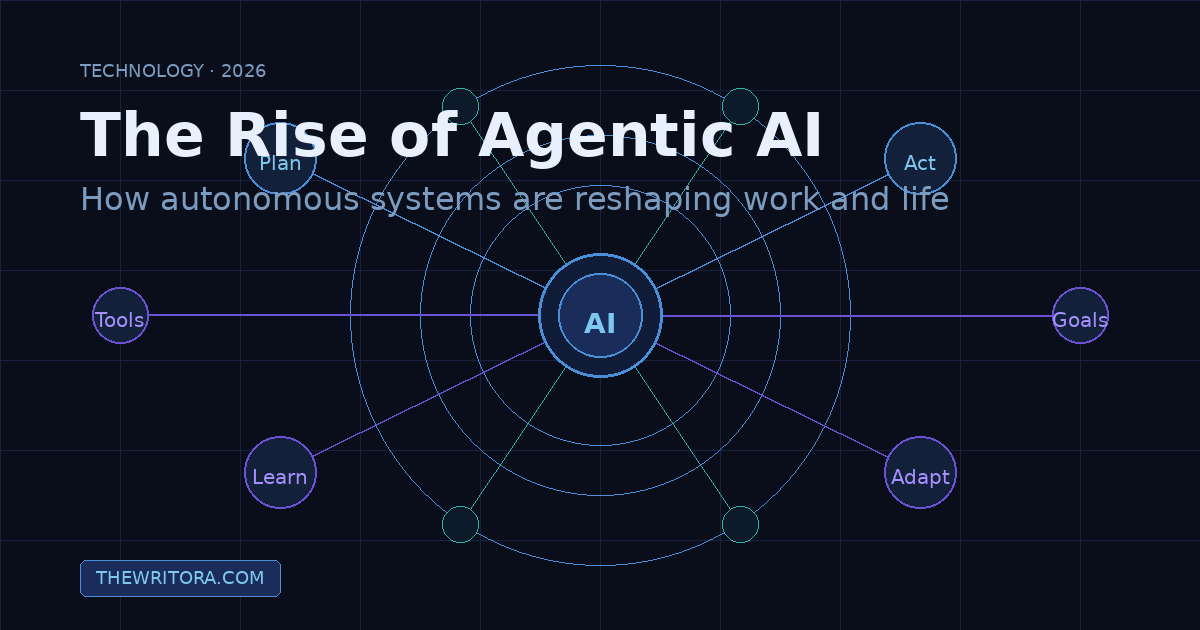
Artificial intelligence is no longer a concept confined to science fiction. From automated workflows to AI-powered hiring tools, the technology is actively transforming how we work, what skills we need, and what the future of employment looks like. For writers — whether you work in content, journalism, copywriting, or fiction — understanding this shift is no longer optional. It is the difference between being ahead of the curve and being left behind by it.
The AI Revolution Is Already Here
Artificial intelligence has moved well beyond academic research and Silicon Valley prototypes. Today, it is embedded in the tools that millions of people use every single day — from the algorithms that sort your inbox, to the software that screens job applications, to the chatbots that handle customer service requests around the clock. The transformation of the workplace is not a distant forecast; it is unfolding in real time.
For writers, this is personal. AI writing tools are already being used by brands, agencies, and publishers to produce first drafts, generate social media copy, and scale content production at speeds no human team can match. The question is not whether this affects you — it does. The question is how you respond.
A 2023 report by the McKinsey Global Institute estimated that up to 30 percent of hours currently worked across the global economy could be automated by 2030, driven largely by advances in generative AI. However, the same report highlighted that automation does not simply eliminate jobs — it reshapes them. Routine and repetitive tasks tend to be automated first, while roles that require emotional intelligence, strategic thinking, and creative problem-solving remain far more resilient.
The World Economic Forum's Future of Jobs Report similarly projects that while 85 million jobs may be displaced by automation, 97 million new roles will emerge — roles better suited to the new division of labour between humans and machines. Many of those roles will involve writing, communication, and storytelling in forms that do not yet exist.
Industries Being Transformed — And What It Means for Writers
No sector is entirely untouched, but some are experiencing faster and more profound changes than others. Each of these shifts creates both a threat and an opening for skilled writers.
Technology and Software Development
AI coding tools such as GitHub Copilot are already helping developers write, review, and debug code faster than ever before. This does not eliminate the need for developers — it changes what they spend their time on. The same logic applies to writers: AI handles the mechanical, the repetitive, the formulaic. What it cannot do is think originally, argue persuasively, or write with a voice that readers trust.
Healthcare
AI-powered diagnostic tools can now detect certain cancers, eye diseases, and heart conditions with accuracy that rivals or exceeds human specialists. According to the U.S. Food and Drug Administration, over 500 AI-enabled medical devices have already received regulatory clearance in the United States. But healthcare still needs skilled medical writers, patient advocates, and science communicators who can translate complex information into language that real people understand and trust.
Education
Adaptive learning platforms powered by AI — such as Coursera and Khan Academy — can tailor curriculum to individual students' pace and learning style. Educators are being repositioned as mentors and facilitators. For writers, this creates growing demand for curriculum developers, e-learning scriptwriters, and educational content specialists.
Finance
Algorithmic trading, fraud detection, and personalised financial advice are all areas where AI is making deep inroads. Financial analysts increasingly find their value in interpretation and client relationships rather than raw data processing. Financial writers and explainers — those who can make complex topics accessible — are more valuable, not less.
Creative Industries
Generative AI tools can produce images, music, video, and written content at scale. While this raises important questions about originality and authorship, it also gives individual creators access to production capabilities that previously required entire teams. A single writer with the right tools today can produce, publish, and distribute work that once required a full editorial department.
The Skills That Will Matter Most
If AI is reshaping what work looks like, the skills required to succeed are also changing. For writers specifically, here is what the evidence suggests will matter most.
AI Literacy
You do not need to be an engineer to benefit from understanding how AI works. Knowing how to prompt AI tools effectively, evaluate their outputs critically, and integrate them into your workflow is quickly becoming a baseline professional skill. Prompt engineering — the art of giving AI models precise, effective instructions — is already a sought-after skill across virtually every industry, and writers are uniquely positioned to excel at it. Language is your medium. Using it to direct AI tools precisely is a natural extension of what you already do.
Analytical and Critical Thinking
As AI handles more routine content production, the ability to interpret results, question assumptions, and construct sound arguments becomes more valuable, not less. Editors, strategists, and senior writers who can evaluate AI-generated content and elevate it are in growing demand.
Emotional Intelligence and Voice
Leadership, negotiation, empathy, and the ability to build genuine trust with readers — these are capacities that AI cannot replicate. A distinctive writing voice, built over years of practice and lived experience, is one of the most durable competitive advantages a writer can have.
Adaptability and Continuous Learning
The half-life of technical skills is shrinking rapidly. Writers who thrive in an AI-driven economy will be those who embrace lifelong learning and remain genuinely curious about change rather than threatened by it. Platforms like LinkedIn Learning and Coursera offer hundreds of courses designed to help professionals upskill in AI-adjacent areas.
Creative Problem-Solving
AI excels at optimisation within defined parameters. It struggles with the kind of lateral, unconventional thinking that produces genuinely new ideas and narratives. Human creativity — your ability to find an angle nobody else has found, to tell a story that resonates — remains a distinct and irreplaceable advantage.
The Opportunity Inside the Disruption
It would be easy to read this landscape as purely threatening. But history offers important perspective. Every major technological revolution — the printing press, the industrial revolution, the internet — initially disrupted existing jobs and created widespread anxiety about the future of work. In each case, the long-term result was an expansion of economic activity, the creation of entirely new job categories, and improvements in living standards.
Artificial intelligence is already creating entirely new roles that did not exist a decade ago: AI trainers, prompt engineers, machine learning ethicists, AI content strategists, and data storytellers. As AI handles more of the routine and transactional work, human attention can be freed for higher-order activities — innovation, caregiving, leadership, community-building — that are more fulfilling and more difficult to automate.
There is also a compelling democratisation argument. AI tools are increasingly accessible to freelancers and independent writers who previously lacked the resources to compete with larger, better-resourced organisations. A solo writer with the right AI tools today can accomplish what once required an entire department.
What Businesses Should Be Doing Now
For organisations navigating this transition, a few principles stand out.
Investing in employee upskilling is not a nice-to-have — it is a strategic necessity. Companies that help their people learn to work effectively alongside AI will retain talent and build competitive advantage. Those that simply automate without investing in their workforce will face mounting costs in turnover, disengagement, and institutional knowledge loss.
The ethical dimensions of AI adoption also deserve serious attention. Bias in AI hiring tools, data privacy concerns, and the displacement of vulnerable workers are real issues that require deliberate policies, not just technical fixes. Businesses that take these concerns seriously will build stronger reputations and avoid regulatory risk.
Finally, AI adoption should be approached as an ongoing process rather than a one-time project. The technology is evolving rapidly, and organisations that build cultures of experimentation and learning will be far better positioned than those that treat AI as a box to be checked.
Practical Steps for Writers and Individuals
If you are a writer looking to navigate this transformation, here are concrete starting points.
Experiment with the tools. Begin by using the AI tools most relevant to your work — whether that means an AI writing assistant, an image generation tool, or a coding companion like GitHub Copilot. Familiarity builds confidence, and confidence translates to competitive advantage. Many tools offer free tiers specifically designed for individuals.
Invest in complementary skills. Communication, leadership, creative thinking, and deep domain expertise are all areas where human capability adds value that AI cannot easily replace. Google's free AI courses and Coursera's AI for Everyone are excellent starting points regardless of your technical background.
Stay informed. The AI landscape is changing fast enough that what is true today may be outdated in six months. Organisations like the MIT Technology Review and the Stanford Human-Centered AI Institute publish accessible, high-quality analysis of where the field is heading.
Build a direct audience. An email list, a newsletter, a consistent presence somewhere you own and control — these are the most durable assets a writer can build. Algorithms change. Platforms collapse. A loyal readership does not.
Do not let anxiety be the dominant emotion. The writers who will struggle most are not those with ordinary skills — they are those who refuse to adapt. Curiosity and a genuine willingness to learn are, in the age of AI, among the most valuable professional assets a person can have.
Looking Ahead
The transformation of work by artificial intelligence is not a single event but an ongoing process that will play out over decades. It will create genuine hardship for some workers and industries, particularly those built around tasks that are easily automated and where retraining pathways are limited. Policymakers, educators, and businesses all have a role to play in ensuring that the benefits of AI are broadly shared rather than concentrated in the hands of a few.
But it is also, unambiguously, a moment of extraordinary possibility. The technology available to writers, creators, and entrepreneurs today would have seemed remarkable a generation ago. The question is not whether AI will reshape the future of work — it already is. The question is whether you will engage with that transformation proactively, thoughtfully, and on your own terms.
For writers, the answer to that question has never mattered more.
What has your experience been with AI tools in your writing work? Share your thoughts in the comments below.