Most coverage of sleep deprivation focuses on the cognitive and physical consequences: impaired memory, reduced reaction time, elevated cardiovascular risk, weakened immunity. These are real and well-documented. But there is a dimension of the sleep crisis that receives considerably less attention, despite the weight of evidence behind it — and that is its relationship to mental health.
The connection between poor sleep and poor mental health is not incidental. It is not simply that people with depression or anxiety tend to sleep badly. The relationship is bidirectional, causally significant in both directions, and — according to a landmark review published in PLOS Mental Health in December 2025 — one of the most important and underutilised targets in the treatment of psychiatric disorders.
Understanding this relationship matters not just for people currently experiencing mental health problems, but for anyone seeking to understand the biological foundations of mood, resilience, and psychological wellbeing.
A Two-Way Street — But Not a Symmetrical One
For most of the twentieth century, the clinical consensus was that sleep problems in psychiatric patients were a symptom of their condition — a secondary consequence of depression or anxiety that would resolve once the underlying disorder was treated. This view has been substantially revised.
The PLOS Mental Health review, synthesising evidence across major depressive disorder, bipolar disorder, anxiety disorders, PTSD, schizophrenia, ADHD, and substance use disorders, concluded that sleep disturbances are now recognised as "active contributors to the onset, course, and relapse of mental illness" — not merely consequences of it. The relationship is bidirectional, but that does not mean it is symmetrical. Sleep problems can precede depression by months or years. Treating the sleep problem directly, rather than waiting for it to resolve when the depression lifts, can significantly change outcomes.
The American Journal of Psychiatry has described insomnia as "an established and modifiable risk factor for depression" — a phrasing that matters clinically, because modifiable risk factors can be targeted before a disorder fully develops. People who struggle with insomnia are at significantly elevated risk of subsequently developing a major depressive episode, even without any prior history of depression. Addressing the sleep problem is not just treating a symptom. It may be preventing the condition it would otherwise contribute to.
The Sleep Foundation describes the anxiety-sleep relationship in similar terms: anxiety disorders disrupt sleep, and sleep deprivation amplifies anxiety, creating a self-reinforcing cycle in which each condition worsens the other. People who are prone to anxiety are particularly sensitive to the effects of insufficient sleep on mood and emotional regulation — which means the group most likely to struggle with sleep is also the group most harmed by the consequences of poor sleep.
What Happens in the Brain
The neurobiological mechanisms through which sleep deprivation produces psychiatric symptoms are increasingly well understood, and they help explain why the relationship is so robust across different disorders.
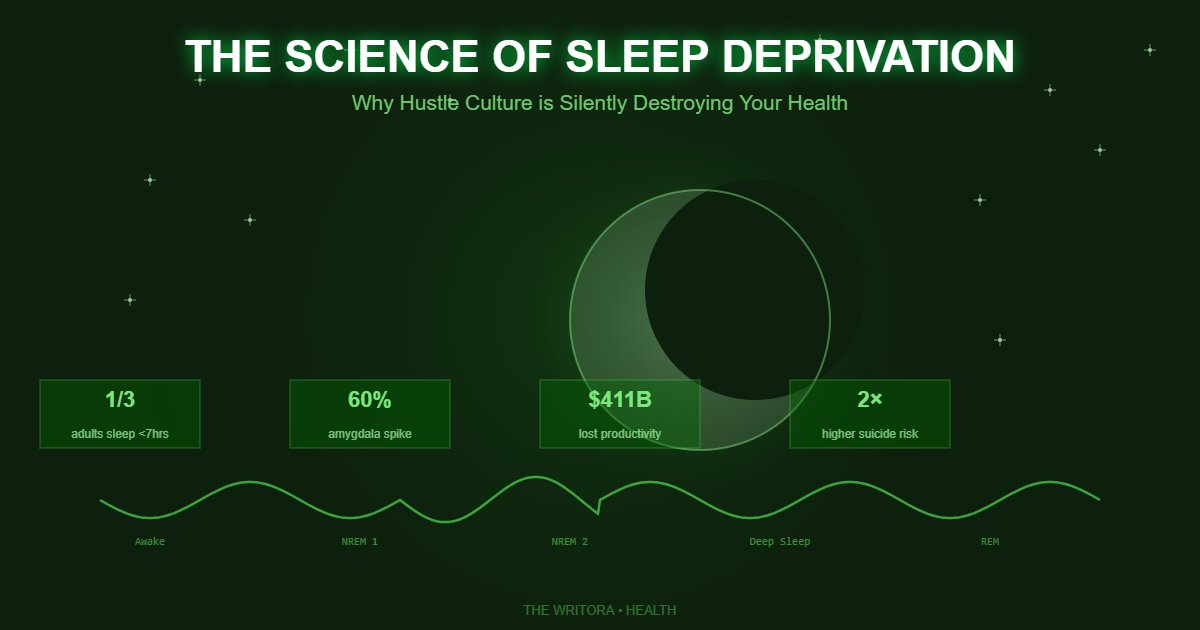
The amygdala — the brain's threat-detection and emotional response centre — becomes significantly more reactive under sleep deprivation. Research has shown that sleep-deprived individuals exhibit up to 60% greater amygdala reactivity to negative stimuli than well-rested controls. Simultaneously, the prefrontal cortex — which normally modulates amygdala responses through top-down regulatory control — becomes less active under sleep deprivation, losing its ability to dampen the amygdala's reactivity. The result is a brain that responds more intensely to perceived threats while having less capacity to regulate those responses.
This neural pattern closely mirrors what is observed in anxiety disorders and major depression. It is, in essence, the neurological signature of those conditions — produced transiently in otherwise healthy people by insufficient sleep, and exacerbated in people who already have these conditions when their sleep deteriorates.
REM sleep appears to play a particularly important role in emotional processing. During REM sleep, the brain replays emotionally significant experiences at lower noradrenergic tone — a neurochemical state that allows the emotional charge associated with difficult memories to be processed and reduced without the same physiological arousal as when those memories were originally formed. When REM sleep is disrupted — which happens disproportionately in people with depression, PTSD, and anxiety — this emotional processing is incomplete. Difficult experiences are stored with their full emotional weight intact rather than being partially neutralised through sleep.
This mechanism helps explain why trauma is so closely linked to sleep disruption, and why treating sleep can have broader effects on trauma-related symptoms than simply improving rest.
The Suicide Risk That Is Rarely Discussed
The most serious and least publicly discussed dimension of the sleep-mental health relationship is its association with suicidal ideation and behaviour.
Research reviewed by Columbia University's Department of Psychiatry documents that sleep problems contribute to the onset and worsening of psychiatric symptoms including suicidal ideation. A large study examining insomnia and suicide risk found that the presence of insomnia symptoms was associated with a 6.2-fold increased risk of suicidal ideation, a 10.4-fold increased risk of making a suicide plan, and a 10.5-fold increased risk of a suicide attempt compared to those without insomnia — findings that held even after adjusting for the presence of depressive disorders.
This is a striking finding. It suggests that insomnia is not merely accompanying depression's suicide risk, but contributing to it through independent mechanisms — likely involving the effects of sleep deprivation on impulse control, pain tolerance, emotional regulation, and the capacity to generate alternative solutions to problems. A sleep-deprived brain, in a state of heightened emotional reactivity and reduced executive control, is less able to resist suicidal thoughts when they arise.
The clinical implication is significant: suicide risk assessment and prevention programmes that do not evaluate and address sleep may be missing an important and treatable contributor. Autopsy studies of suicide victims have found sleep disturbances to be more prevalent than in matched controls, even after adjusting for affective disorders — further evidence that the sleep-suicide relationship operates through pathways beyond depression alone.
Why Treatment Approaches Need to Change
If sleep disturbances are active contributors to mental health disorders rather than secondary symptoms, this has direct implications for how those disorders should be treated — and the evidence suggests that clinical practice has been slow to catch up.
The standard approach to treating depression has historically been antidepressant medication and psychotherapy, with sleep addressed secondarily if it remained problematic after the primary treatment. The emerging evidence supports a different approach: treating the sleep problem directly and early, in parallel with or even ahead of other interventions, because doing so may improve outcomes on both dimensions.
Cognitive Behavioural Therapy for Insomnia (CBT-I) has a strong and growing evidence base as a first-line treatment for chronic insomnia — consistently outperforming sleep medication in long-term outcomes with no dependency risk. What is newer and more striking is the evidence that CBT-I also produces improvements in depression and anxiety symptoms, and reduces suicidal ideation, even in patients whose primary presenting problem was not sleep.
A randomised controlled trial published in the journal Sleep in 2022 found that patients with baseline suicidal ideation who completed CBT-I reported suicidal ideation at post-treatment in 30% of cases, compared to 54.5% of those in the control condition. At one-year follow-up, the difference was maintained: 29.6% versus 46.8%. Critically, the reduction in suicidal ideation was significantly associated with insomnia remission itself — not merely with changes in depression severity — confirming that the sleep improvement was doing independent therapeutic work.
A 2025 review in PLOS Mental Health concluded that directly addressing sleep "significantly improves psychiatric outcomes, reducing symptoms of depression and anxiety, decreasing suicidal ideation, and lowering relapse risk in bipolar disorder and psychoses" — a breadth of effect that is unusual for any single therapeutic target.
The National Institute of Mental Health now recognises sleep disturbance as both a symptom and a causal factor in major depressive disorder. The clinical guidance is moving in the direction that the research has been pointing toward for a decade: treat the sleep.
The Pandemic as a Case Study
The COVID-19 pandemic provided an inadvertent large-scale experiment in the relationship between sleep disruption and mental health deterioration.
A study of 22,330 adults from 13 countries published in Sleep Medicine in 2021 found that one in three participants had clinical insomnia symptoms during the pandemic — rates more than double those observed before it. Sleep disturbances were strongly linked to higher levels of psychological distress across the sample, and anxiety and depression rates were substantially elevated alongside the sleep disruption.
The pandemic disrupted sleep through multiple mechanisms simultaneously: altered routines removing the social anchors of consistent schedules, reduced natural light exposure from diminished outdoor activity, increased screen time, chronic low-level anxiety about health and economic security, and for many people, the acute trauma of bereavement, illness, or acute financial crisis. The mental health consequences were severe and widely documented. The sleep dimension of those consequences received less attention than it warranted.
As the pandemic's direct effects receded, the insomnia it triggered did not automatically resolve for many people. Chronic insomnia, once established, tends to persist through conditioning processes — the bed becomes associated with wakefulness and anxiety rather than with sleep — that require active intervention to break. Millions of people who developed insomnia during the pandemic continue to experience it, and are at elevated risk for the downstream mental health consequences the evidence predicts.
What This Means in Practice
The practical implications of this research converge on a few clear points.
Sleep is a mental health intervention, not just a health metric. Improving sleep is not merely about feeling more rested. It is about reducing the biological conditions that make depression, anxiety, and other psychiatric disorders more likely to develop, more severe when they occur, and more likely to relapse after treatment.
CBT-I should be more widely available and more widely used. It is the most evidence-based treatment for insomnia available, it produces effects beyond sleep itself, and it has no side effects or dependency risk. Digital CBT-I programmes — including Sleepio, which has been evaluated in randomised trials — have significantly expanded access to this intervention beyond the clinic, making it available to people who cannot access in-person therapy.
Mental health assessment should include sleep. Any clinical evaluation of depression, anxiety, PTSD, or other psychiatric conditions that does not include a thorough assessment of sleep is missing a potentially important contributor. The reverse is also true: anyone presenting with chronic insomnia should be assessed for depression and anxiety, because the conditions co-occur at high rates and each complicates the treatment of the other.
The bidirectional relationship creates an opportunity. Because sleep and mental health influence each other, improving either can create a virtuous cycle rather than a vicious one. A person who improves their sleep through CBT-I may find their anxiety diminishes; reduced anxiety makes further sleep improvement more achievable; better sleep reduces depression risk; reduced depression makes consistent sleep schedules easier to maintain. Entry into this cycle from the sleep side is often more accessible than entry from the psychiatric side — partly because sleep problems carry less stigma, and partly because effective treatment is available without the delays and access barriers that complicate mental health care in most countries.
A Connection That Deserves More Attention
The relationship between sleep and mental health is among the most robustly established and most underutilised findings in contemporary psychiatry. The evidence is clear that poor sleep does not merely accompany mental health problems — it helps cause them, sustain them, and worsen their most serious outcomes. And the evidence is equally clear that treating sleep effectively produces mental health benefits that extend well beyond simply feeling more rested.
This is not a niche finding. It has direct implications for how mental health is treated, how psychiatric risk is assessed, and how individuals make sense of their own psychological experiences. The connection deserves to be far better known than it currently is.
If you are experiencing difficulties with sleep or mental health, please consider speaking with a healthcare professional. In a crisis, please reach out to a mental health helpline in your country — in Kenya, you can contact the Befrienders Kenya at +254 722 178 177.
Have you noticed a connection between your sleep and your mental health? Share your experience in the comments below.