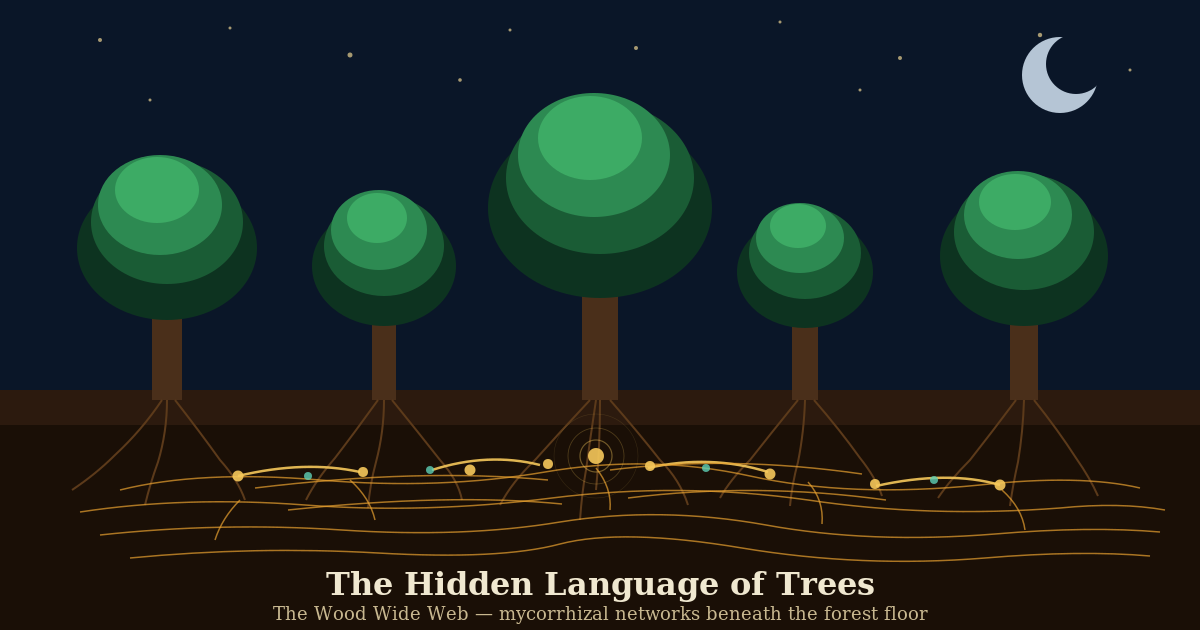
Beneath every ancient forest, invisible to the naked eye, lies one of the most sophisticated communication networks on Earth. It does not run on fibre optic cables or radio waves. It is woven from the thread-like filaments of fungi — a living web that connects trees across hectares of forest floor, allowing them to share resources, exchange chemical signals, and respond collectively to threats.
Scientists call it the mycorrhizal network. The popular press gave it a catchier name: the Wood Wide Web.
What began as a fringe idea in the 1990s has matured into one of the most exciting and contentious frontiers in biology. The more researchers learn, the more extraordinary — and the more complicated — it becomes.
A Discovery That Changed How We See Forests
The story of the Wood Wide Web begins in 1997, with a young Canadian forest ecologist named Suzanne Simard and a paper in the journal Nature that would upend three decades of conventional thinking about how forests work.
Simard's experiment was elegant. Using radioactive carbon isotopes as tracers, she demonstrated that carbon was moving between trees through underground fungal connections — and not randomly. Larger, older trees were sending disproportionate amounts of carbon to smaller seedlings growing in their shade. The trees were not simply competing. They were sharing.
In subsequent decades of research, Simard and her colleagues at the University of British Columbia found that these large "mother trees" — her term for the dominant hubs of the fungal network — appeared to recognise their own offspring. When seedlings of their own species grew nearby, mother trees sent more carbon to them than to unrelated seedlings. They also pruned their own root systems to make room for their young. This was not the competitive, every-organism-for-itself model that biology had long assumed. It was something more complex.
Her memoir, Finding the Mother Tree, brought these ideas to a wide public audience and sparked a cultural moment around the idea of forests as communities rather than collections of competing individuals.
What Mycorrhizae Actually Are
The science underlying the Wood Wide Web begins with mycorrhizae — from the Greek mykos (fungus) and rhiza (root). These are symbiotic relationships between fungi and the roots of plants, and they are extraordinarily ancient: stretching back at least 400 million years, they are thought to have played a critical role in enabling the first plants to colonise dry land.
Today, over 90% of all plant species form mycorrhizal partnerships. The fungi attach to and often penetrate plant root cells, extending their threadlike hyphae outward into surrounding soil. In exchange for receiving carbon-rich sugars produced by photosynthesis, the fungi dramatically extend the plant's access to phosphorus, nitrogen, and water — minerals the plant could not reach on its own.
What researchers discovered is that these fungal threads do not simply connect one tree to one fungus. They connect trees to each other — forming vast colony-wide networks through which carbon, water, nutrients, and chemical signals can travel across an entire forest.
According to research championed by evolutionary biologist Professor Toby Kiers of Vrije Universiteit Amsterdam — who won the 2026 Tyler Prize, sometimes called the environmental Nobel, for her work in this field — mycorrhizal fungi collectively draw down approximately 13 billion tonnes of CO₂ per year. That is roughly a third of all annual fossil fuel emissions, sequestered through a biological process happening silently beneath our feet.
The Forest as a Chemical Warning System
Trees do not only share carbon through the network. They use it to send distress signals.
When a Douglas fir is attacked by insects, it releases chemical compounds into the mycorrhizal web. Neighbouring trees, receiving these signals, begin producing defensive chemicals of their own — before they have been touched by a single pest. Researchers have traced these signals directly, watching concentrations of defence compounds rise in connected trees within hours of a neighbour being attacked. The network functions, in effect, as a forest-wide immune system.
Other experiments have shown that trees under drought stress release signals that prompt neighbours to adjust their stomata — the tiny pores through which they exchange gases — reducing water loss across a wider community of trees. It is a form of collective resource management that evolution has refined over hundreds of millions of years, long before anything remotely resembling intelligence appeared on this planet.
The Underground Economy
The exchange of carbon through the mycorrhizal network is not simply altruistic. Professor Kiers' most influential work, published in Science in 2011, demonstrated that the fungi behave like shrewd traders in a biological marketplace — making decisions based on supply and demand, routing more nutrients toward plants that offer more sugar in return, and reducing flows to those that provide less.
Using fluorescent quantum dots as tracers, Kiers and her team produced high-resolution video footage inside living fungal networks, watching nutrients move and accumulate in patterns that closely mirrored economic market behaviour. The fungi were not passively channelling resources. They were actively managing them.
This underground economy may explain why diverse, interconnected forests are so much more resilient than simplified monoculture plantations. A forest with multiple species linked by a shared fungal network shares risk. When one species struggles, others can compensate. The network buffers the whole system against drought, disease, and disturbance in ways that isolated trees simply cannot.
A Scientific Debate Worth Taking Seriously
Not everyone is convinced by the more expansive claims made about the Wood Wide Web — and the scientific debate is worth understanding honestly.
A 2023 paper in Nature Ecology & Evolution argued that some of the most widely cited findings about inter-tree carbon transfer have been overstated or misinterpreted in popular accounts, and that positive citation bias had led to a romanticised picture that the evidence does not fully support. The paper caused significant discussion within the research community.
Professor Kiers herself has consistently urged caution against overly anthropomorphic interpretations. The mycorrhizal network is not a benevolent brain directing the welfare of the forest. It is an evolved system in which cooperation and competition both occur, often simultaneously, driven by each participant's own survival imperatives. Some plants — such as Monotropa uniflora (ghost pipes) — have evolved to exploit the network without contributing to it, stealing carbon from trees without performing any photosynthesis. Some tree species appear to use the network to pump natural herbicides into the root zones of competitors.
The forest floor, peaceful as it appears from above, is also a theatre of chemical warfare.
What the scientific debate reveals is not that the Wood Wide Web is a myth, but that reality is richer and stranger than any simple narrative — cooperative or competitive — can capture. The mycorrhizal network is real, it is extraordinary, and it is still being understood.
What Happens When the Network Is Destroyed
The mycorrhizal network is sensitive to disturbance in ways that have significant implications for how we manage land.
Soil compaction, pesticide use, and tillage in agricultural settings can devastate fungal communities. Industrial logging practices — particularly clear-cutting, which removes the old-growth mother trees that anchor the network — can sever the connections that allow forest regeneration to proceed. Without the fungal network, replanted forests often struggle. Seedlings planted in disturbed soil, without established fungal partners to connect to, must fend for themselves. Growth is slower, mortality is higher, and the community dynamics that make forests resilient are absent for decades.
Recent research shows that inoculating seedlings with mycorrhizal fungi before planting, or deliberately retaining large old trees as network anchors during selective harvesting, dramatically improves survival rates. These are not marginal improvements — they represent a fundamental rethinking of reforestation practice informed directly by the science of underground networks.
Professor Kiers co-founded the Society for the Protection of Underground Networks (SPUN), which is building a global map of mycorrhizal biodiversity — an Underground Atlas — to guide conservation decisions and identify the fungal ecosystems most at risk from agriculture, urbanisation, and climate change.
What This Changes
The deepest implication of the Wood Wide Web may be philosophical as much as scientific.
For centuries, Western biology viewed nature primarily through a competitive lens — as a perpetual struggle of each organism against every other, with cooperation appearing only as a special case. What the mycorrhizal network suggests is that cooperation may be just as fundamental a force in evolution as competition, operating across species boundaries and timescales that individual organisms cannot perceive.
A forest is not a collection of individual trees. It is a community — perhaps even, as some researchers argue, a kind of superorganism — in which individuals are linked by invisible threads that blur the boundary between self and other.
We are only beginning to understand the full extent of this hidden language. Every year, new studies push further: trees that distinguish their own kin from strangers, that respond to sound vibrations in their root zones, that appear to pass memories of past stresses to their offspring through epigenetic signals in seeds.
The forest, it turns out, has always been communicating. We are only now developing the tools to listen.
What aspect of forest science do you find most surprising? Share your thoughts in the comments below.