Somewhere in the world, approximately every two weeks, a language dies.
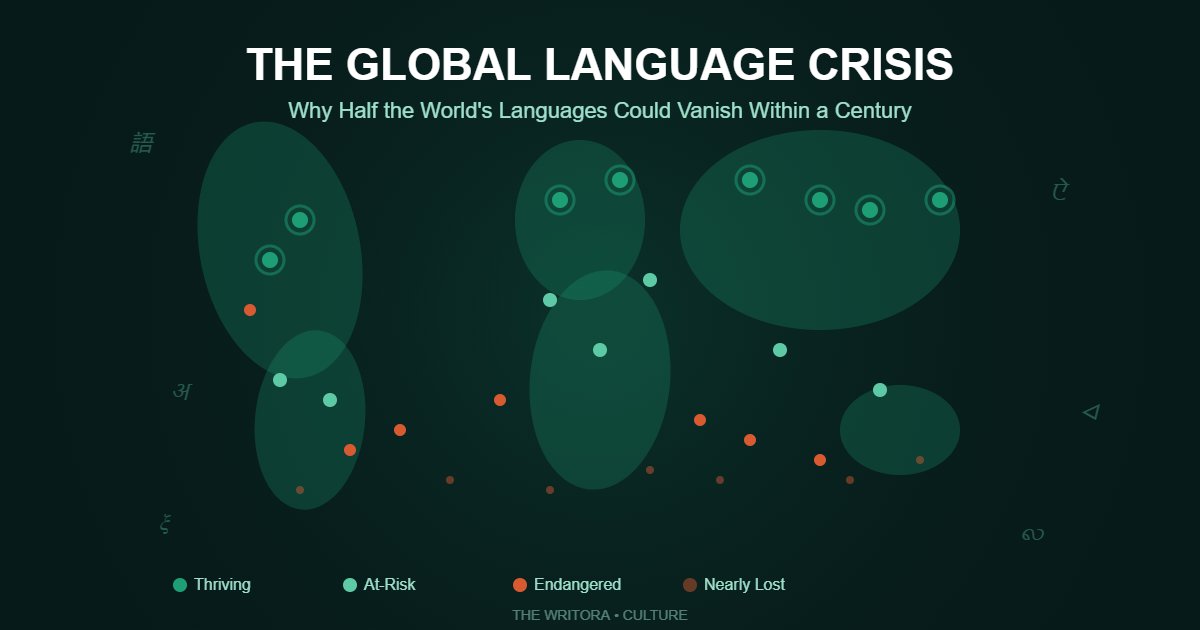
Not with headlines or memorials. Quietly, when the last fluent speaker — often an elderly person in a remote community — passes away, taking with them something that may have taken thousands of years to develop. According to Ethnologue, the most comprehensive catalogue of the world's living languages, 3,226 languages are currently endangered — 43.5% of all languages spoken on Earth. Linguists estimate that between 50% and 90% of them will be severely endangered or extinct by the end of this century.
This is not a slow background process of natural change. It is an accelerating crisis — one that the Catalogue of Endangered Languages at the University of Hawai'i describes as unprecedented in its scale and speed. As far as researchers know, there has never been a time in human history when linguistic diversity has faced destruction at this rate.
The Scale of What Is Being Lost
To understand why linguists use words like "catastrophic" to describe what is happening, it helps to understand what a language actually is.
A language is not merely a communication system — a set of labels attached to things in the world that could, in principle, be replaced by another set of labels without loss. A language is a cognitive framework: a particular way of organising perception, time, space, social relationships, and experience that has been refined over generations of speakers living in specific environments and facing specific circumstances. Languages differ not just in vocabulary and grammar but in what they make it possible to say precisely, what distinctions they draw automatically, and what aspects of experience they bring into focus.
Languages vary in how they encode spatial orientation — some use absolute directions (north, south, east, west) rather than relative ones (left, right), training speakers from childhood to maintain a constant sense of cardinal direction. They vary in how they divide the colour spectrum, with different languages drawing boundaries between colours in different places, affecting how speakers perceive colour similarity. They vary in how they encode time — whether the past is behind you and the future ahead, or whether ancestral time is in front because it is known and the future is behind because it has not yet been seen. They vary in how many words they have for specific emotional states, specific ecological phenomena, specific social relationships.
The UNESCO Atlas of the World's Languages in Danger currently lists approximately 3,000 languages across categories from "vulnerable" to "critically endangered." More than 400 languages have disappeared in the past century alone. Each one represented a distinct way of perceiving and organising human experience. None of them can be fully reconstructed from recordings or dictionaries. The living language — the way it was used, varied, evolved, and embedded in the lives of its speakers — is gone.
Why Languages Disappear
Language death rarely occurs because people are prevented from speaking at gunpoint — though history offers examples of exactly that. Far more commonly, it unfolds over generations through a process that linguists call language shift: speakers of smaller languages gradually adopt dominant languages for the contexts where it counts, and transmission to the next generation breaks down.
The mechanism is straightforward and the pressures driving it are real. Economic participation in modern societies frequently requires proficiency in dominant languages. In many countries, formal schooling is conducted exclusively in the national language. Broadcasting, social media, and the internet overwhelmingly favour a handful of global languages — Ethnologue estimates that just 23 languages account for more than half the world's speakers. Against these structural forces, a language spoken by a few hundred people in a remote community can seem to offer little practical utility to the young people who might carry it forward.
Parents make rational decisions. A child who speaks the regional or national language fluently has better access to education, employment, and opportunity than one who does not. The decision to prioritise that language at home is understandable — and cumulatively, across millions of families, it is devastating for linguistic diversity.
The Living Tongues Institute for Endangered Languages identifies several "language hotspots" — regions where linguistic diversity is exceptionally high and exceptionally threatened simultaneously — including the northern Pacific Rim, Oklahoma, and central South America. In Papua New Guinea alone, over 800 languages are spoken — more than a tenth of the world's total — in a country of fewer than 10 million people. Many of these languages are spoken by communities of a few hundred people or fewer, and the social and economic forces pulling younger generations toward Tok Pisin and English are powerful.
The Colonial Legacy
The current language crisis cannot be understood without its historical context, because the forces that have driven it are not purely economic or demographic. They are also political and deliberate.
Colonial powers systematically suppressed indigenous languages as a tool for dismantling distinct cultural identities and integrating — or simply controlling — populations. In residential school systems across North America, Australia, and New Zealand, indigenous children were punished for speaking their languages. The policy was explicit: eliminate the language, eliminate the culture, eliminate the resistance. Generations of children were taught to associate their ancestral tongue with punishment, shame, and backwardness.
The consequences of those policies persist. Communities that were once actively punished for speaking their languages now struggle to reclaim them even where the will exists — because the chain of intergenerational transmission was broken, and breaking it is far easier than repairing it. The grandchildren of fluent speakers may have no fluency at all and face the challenge of learning their ancestral language as adults, which is a fundamentally different process from acquiring it as a child in a community of speakers.
The relationship between national unity and linguistic diversity remains politically contested in countries across the world — from Spain, where the status of Catalan, Basque, and Galician has been a recurring political conflict, to India, where Hindi promotion has sparked sustained protests in southern states, to Bolivia, which has recognised 37 official languages in its constitution. Decisions about which languages receive legal recognition, which are taught in schools, and which are permitted in courts and government offices have direct consequences for whether minority languages can survive.
What Is Lost Beyond the Language Itself
The case for linguistic preservation is sometimes characterised as sentimental — as prioritising cultural continuity over the practical needs of communities who might genuinely benefit from adopting more widely spoken languages. It is worth taking the practical counter-arguments seriously, because the honest case for language preservation is stronger than sentimentality alone can support.
Many indigenous languages encode knowledge about local ecosystems that has been developed and refined over millennia — precise knowledge of the properties of plants with medicinal value, of animal behaviour, of the management of land and water in ways adapted to specific environments and climates. This knowledge is often embedded in the language itself: in the vocabulary, in the names of things, in the distinctions the language draws that other languages do not. Ethnobotanists and medical researchers have documented numerous cases where indigenous vocabulary pointed researchers toward compounds that became the basis of pharmaceuticals. When the language dies, that knowledge does not automatically transfer to other languages — it frequently disappears with it.
There is also growing scientific evidence that different languages produce measurably different cognitive effects in their speakers — not because of biological difference, but because different languages provide different cognitive tools. Research on the relationship between language and spatial cognition, colour perception, and temporal reasoning has consistently found that the language you speak shapes how you perceive certain aspects of the world. Losing a language means losing a cognitive framework — a distinct way of attending to and organising experience that cannot be fully replicated in another tongue.
When Revitalisation Succeeds: Three Case Studies
Language death is not inevitable. The history of language revitalisation offers genuine examples of communities that have reversed the trajectory — and the lessons from those examples are instructive.
Hebrew is the most dramatic case. By the nineteenth century, Hebrew had been functionally extinct as an everyday spoken language for nearly two millennia — preserved as a language of liturgy and scholarship but not spoken natively by anyone. Through a deliberate, sustained, community-wide effort beginning in the late nineteenth century, driven primarily by the early Zionist movement and centred on collective communities called kibbutzim where Hebrew was the language of daily life, Hebrew was revived. Today it has over 9 million speakers and is the primary language of Israel. It is the only documented case of a dead language being fully restored to native everyday use.
Welsh has achieved something almost equally remarkable: stabilisation and partial recovery of a language that was in steep decline through the twentieth century. Through sustained government support, mandatory Welsh-language education, the establishment of S4C — the world's first Welsh-language television channel, launched in 1982 — and a broader cultural movement that made Welsh-speaking a source of pride rather than a marker of rurality and backwardness, Welsh has stabilised at around 880,000 speakers, approximately 29% of Wales's population. It is not out of danger, but it has stopped declining — and among younger generations, use of Welsh is growing.
Māori in New Zealand offers a third model. After a period of severe decline driven by colonial suppression and assimilationist education policy, a community-led revitalisation movement in the 1980s established Kōhanga Reo (language nest) preschools where children were immersed in Māori from infancy. The model spread into primary and secondary schools. Today, more than one in six native Māori can speak the language — the highest figure since the early twentieth century — and the trend is upward.
What these three cases share is the combination of community-driven commitment, institutional support, and — critically — the immersion of children in the language from an early age. Adult language learning is valuable. It does not produce native speakers. The revitalisation of a language requires children who grow up in it.
Technology: New Tools for an Ancient Problem
Technology has opened possibilities for language documentation and transmission that did not exist a generation ago, and the tools are being used actively.
The Endangered Languages Project, supported by Google, has documented hundreds of languages in searchable, publicly accessible form — creating archives of recorded speech, grammar documentation, and vocabulary that ensure at least some record will survive even if the language does not. The Living Tongues Institute has developed rapid documentation methodologies that allow linguists working with elderly speakers to capture as much as possible in the limited time available.
Beyond documentation, technology is increasingly being used for transmission. YouTube channels teaching ancestral languages. Mobile apps for vocabulary and pronunciation practice. Community radio broadcasts in endangered languages. Social media communities where speakers scattered by diaspora can practise and maintain connection. These tools are not sufficient on their own — a language cannot be revitalised through an app — but they provide support structures that communities attempting revitalisation can build on.
Artificial intelligence has begun to contribute in specific ways: building speech recognition and text-to-speech systems for languages too small for commercial companies to address, creating translation tools that make digital content accessible in endangered languages, and enabling more efficient documentation of grammatical structures. The Mozilla Foundation's Common Voice project has expanded to include dozens of endangered and minority languages, collecting voice recordings that can be used to train speech technology.
The Political Question Underneath the Linguistic One
Language policy is never purely technical. It is always also political — about who has power, whose knowledge counts, whose identity is valued, and what kind of society a nation chooses to be.
The suppression of indigenous languages was not accidental. It was deliberate policy, pursued because those in power understood that language is central to identity, culture, and resistance. The communities whose languages are most threatened today are disproportionately the same communities that have been most systematically marginalised — indigenous peoples, ethnic minorities, nomadic groups, populations displaced by conflict or economic pressure.
Language revitalisation, where it succeeds, is therefore rarely just about linguistics. It is about communities reclaiming agency over their own cultural futures, governments recognising the legitimacy of diversity rather than requiring homogeneity, and the broader society deciding that the richness represented by human linguistic diversity is worth the practical and political investment required to sustain it.
The Māori revitalisation movement was not primarily a linguistic project. It was a cultural and political one — a community asserting that its language, and the identity and knowledge it carried, deserved to survive. The linguistic outcome was a consequence of that assertion being taken seriously.
A Cultural Emergency Without Photographs
Language death lacks the visual spectacle of environmental catastrophe. There are no dramatic images, no bleached skeletons, no before-and-after photographs. It happens quietly, in living rooms and community halls, as elderly speakers pass and younger generations turn toward languages the world rewards more immediately.
But its scale and speed make it one of the most significant cultural losses of our time. Of the roughly 7,000 languages spoken today, nearly half are in danger of being silenced within the next few generations. If current trends continue, the linguistic diversity of humanity — the full range of distinct ways human beings have developed to perceive, organise, and communicate their experience of the world — will be reduced by half in the lifetime of children already born.
What digital archives can preserve are recordings and vocabularies. What they cannot preserve is the living language: the way it changes in use, the way it varies between speakers, the way it carries culture and knowledge in structures that cannot be extracted and stored. The question of whether that loss is prevented is, ultimately, a question about what kind of world we want to inhabit — and how seriously we take the proposition that human diversity, in all its forms, is worth the effort to sustain.
Do you speak an endangered language, or have you been involved in language revitalisation efforts? Share your experience in the comments below.